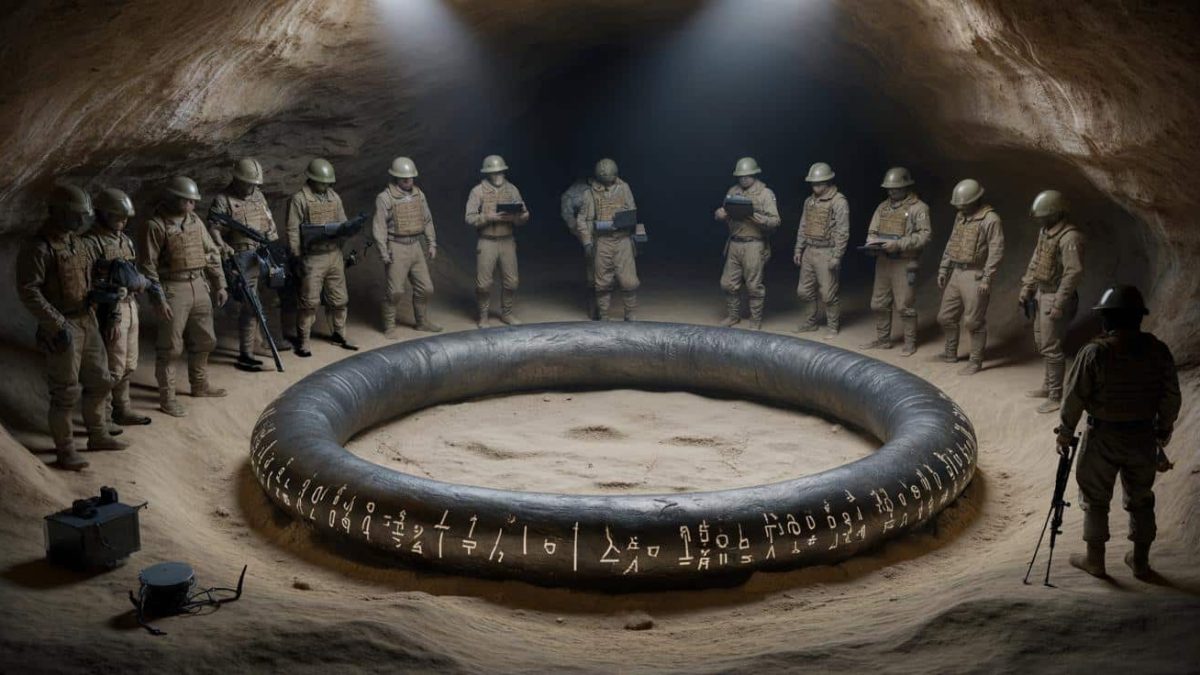
The ocean has always served as Earth’s final frontier, a vast expanse that covers more than seventy percent of our planet yet remains largely unexplored. While we’ve sent humans to space and mapped distant galaxies, the depths of our own oceans continue to guard secrets that could fundamentally alter our understanding of human history. Recently, a remarkable discovery made during a classified military operation has emerged, revealing evidence that could reshape everything archaeologists thought they knew about ancient civilizations.
The Depths Hold Ancient Secrets
At a staggering depth of 2,570 meters below the surface, military personnel conducting what was initially a routine deep-sea surveillance operation stumbled upon something extraordinary. The discovery wasn’t made through traditional archaeological excavation or careful scientific methodology, but rather during advanced undersea exploration using cutting-edge military submarine technology designed for purposes far removed from historical research.
The location, situated in a previously unremarkable section of the Atlantic basin, yielded evidence of structured formations that cannot be easily explained by natural geological processes. Initial photographs and sonar readings suggest organized patterns and arrangements that indicate deliberate construction and placement, characteristics that distinguish intentional human activity from random natural phenomena.
Challenging Conventional Timelines
One of the most compelling aspects of this discovery involves its implications for established archaeological chronologies. Current scientific consensus places the earliest known civilizations in Mesopotamia and Egypt, dating back roughly five to six thousand years. However, the artifacts and structures found at this extreme depth suggest a timeline that predates these widely accepted benchmarks by potentially thousands of years.
This discovery forces archaeologists and historians to reconsider fundamental assumptions about human development and migration patterns. If advanced civilizations existed in locations now submerged beneath thousands of meters of ocean water, this would necessitate a complete reimagining of how and when humans first organized into complex societies.
Advanced Technology Reveals Hidden History
The military’s sophisticated submarine and sonar systems, originally developed for strategic defense purposes, proved instrumental in this groundbreaking find. These technologies operate with precision and sensitivity far exceeding what civilian research institutions can typically afford or access. The detailed imagery captured by these systems revealed geometric patterns and architectural elements that would be invisible to standard underwater exploration equipment.
What makes this discovery particularly significant is that it represents only the beginning of potential revelations. The initial survey covered a limited area, yet yielded substantial findings. Imagine the possibilities that await further exploration of the surrounding region. Scientists estimate that tens of thousands of square kilometers in similar deep-ocean zones remain completely unexplored, any of which could harbor additional evidence of submerged civilizations.
Environmental Factors and Ancient Adaptation
One of the most fascinating questions raised by this discovery concerns environmental conditions during the periods when these structures were presumably built. Current ocean levels are significantly higher than they were during previous ice ages, when vast quantities of water remained locked in polar ice sheets and glaciers. This geological reality provides a plausible explanation for how civilizations could have thrived in areas now inaccessible to modern human habitation.
During the last glacial maximum, approximately twenty thousand years ago, sea levels were substantially lower—perhaps as much as one hundred to one hundred fifty meters below current levels. This would have created entirely different coastlines and potentially habitable regions that are now submerged. The discovered structures could represent remnants of thriving settlements from these ancient periods, preserved in the ocean depths long after their surface civilizations were inundated by rising seas.
Implications for Future Archaeological Research
This discovery promises to revolutionize underwater archaeology and establish new research priorities for scientific institutions worldwide. Universities and research organizations that previously focused on terrestrial digs are now considering how undersea exploration might yield comparable or even greater insights into human prehistory.
The collaboration between military organizations and civilian researchers, previously limited by security concerns and bureaucratic boundaries, may become increasingly necessary as we seek to understand the full scope of submerged archaeological sites. The technical expertise required to operate at extreme depths and analyze sonar data demands interdisciplinary cooperation and shared resources.
The Race to Preserve History
Environmental pressures present an urgent timeline for further investigation. Ocean acidification, deep-sea mining operations, and other anthropogenic factors pose threats to preservation of these ancient artifacts. Unlike terrestrial archaeological sites that can be protected through legal designations and physical barriers, deep-sea locations require international cooperation and sophisticated monitoring to preserve them for future study.
Scientists emphasize the importance of documenting and studying these discoveries before natural or human-caused degradation compromises the sites. Each passing year brings environmental changes that could obscure evidence or damage fragile artifacts that have survived millennia in ocean conditions.
What Comes Next
The military’s classified discovery has sparked intense discussion within academic circles about what other secrets might lie beneath the ocean’s surface. Research institutions are now proposing comprehensive deep-sea surveys targeting regions where geological evidence suggests ancient coastlines once existed. These expeditions will require significant funding and technological resources, but the potential historical revelations justify the investment.
As we advance our understanding of human history through this remarkable discovery, we’re reminded that our planet still contains mysteries waiting to be uncovered. The ocean floor, once thought to be merely a barren landscape of sediment and rock, has revealed itself as a repository of human achievement and testament to the resilience and ingenuity of ancient peoples who adapted to environments we’re only now beginning to understand.
This discovery represents not an endpoint but rather an exciting beginning—the opening chapter of a new era in archaeological research where the deepest, darkest reaches of our world may illuminate the brightest moments of our distant past.










Leave a Comment