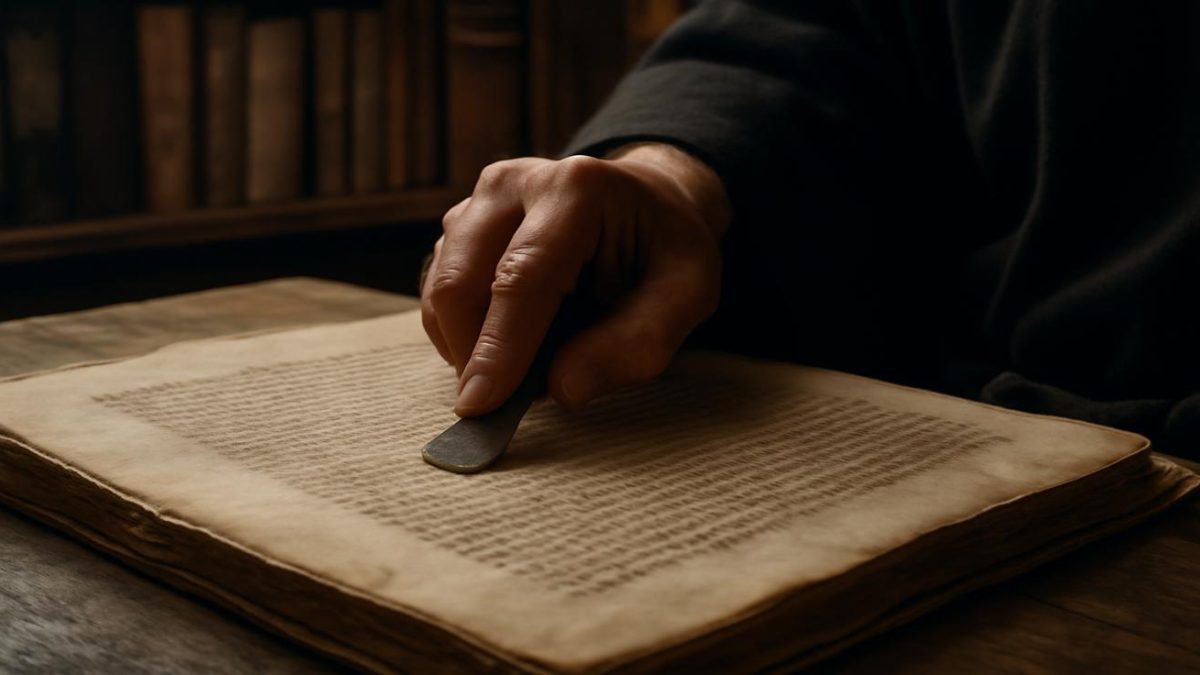
Few historical events illustrate the fragility of human knowledge quite like the fate of Archimedes’ lost treatise. In the dark corridors of a medieval monastery, invaluable mathematical insights—some fifteen centuries ahead of their time—were methodically scraped from parchment and replaced with religious texts. This wasn’t an act of deliberate destruction but rather an economical necessity that would cost humanity dearly.
The Economics of Parchment
During medieval times, parchment was an extraordinarily precious commodity. Made from treated animal hides, it represented a significant investment for monasteries with limited resources. The process of creating new parchment was time-consuming, expensive, and labor-intensive. When monks needed writing material for their religious manuscripts, they often turned to existing documents that were considered less essential, carefully erasing the original text to reuse the surface.
These reused manuscripts became known as palimpsests, derived from the Greek words meaning “scraped again.” What made this practice particularly tragic in the case of Archimedes was that his mathematical works were being replaced by religious commentaries. The monks, bound by their devotion to scripture and theology, had no way of knowing they were obliterating some of history’s most advanced scientific thinking.
Who Was Archimedes?
Archimedes of Syracuse lived during the third century BCE and is widely regarded as one of antiquity’s greatest mathematicians and physicists. His contributions spanned geometry, calculus, physics, and engineering. He developed methods for calculating areas and volumes of complex shapes, anticipated concepts that wouldn’t be formally developed for nearly two thousand years, and created ingenious mechanical devices that served Syracuse during military sieges.
His work represented a quantum leap in mathematical sophistication. Unlike many ancient scholars who worked primarily through geometric observation, Archimedes employed rigorous logical proofs and invented novel approaches to solving problems. His manuscripts would have provided invaluable insights into the development of mathematical thought and potentially accelerated the scientific revolution by centuries had they remained accessible.
The Journey of a Precious Text
The manuscript containing Archimedes’ works survived the fall of the Roman Empire and the collapse of classical civilization. It eventually made its way to Constantinople, where it was preserved in libraries that maintained the intellectual heritage of the ancient world. However, as the Byzantine Empire struggled with its own challenges, the manuscript’s significance diminished in the eyes of those responsible for its safekeeping.
By the tenth century, the document had been transported to a monastery in Jerusalem. It was here that the fateful decision was made. The parchment, though bearing the greatest mathematical innovations of antiquity, was deemed expendable. Monks carefully washed away the original text, which had faded over centuries, and wrote over it with religious commentaries and prayers. The original Archimedes text didn’t disappear entirely—faint traces remained beneath the new writing, invisible to the naked eye but not lost forever.
The Rediscovery
The palimpsest vanished from historical records for centuries, eventually making its way through various collections and eventually to Istanbul. It wasn’t until the nineteenth century that scholars began recognizing fragments of Archimedes’ handwriting beneath the religious text. However, the full significance of the discovery wasn’t appreciated until the early twenty-first century, when modern imaging technology revolutionized our ability to read obscured documents.
Using ultraviolet light, X-ray fluorescence, and advanced digital imaging, researchers were able to reconstruct nearly all of the erased text. What they found astonished the scientific community. The palimpsest contained works that had previously been lost entirely, including Archimedes’ Method—a treatise describing his revolutionary approach to mathematical problem-solving that bore striking similarities to integral calculus, a field that wouldn’t be formally developed until the seventeenth century.
The Lost Knowledge
Among the recovered texts was Archimedes’ proof of the sphere’s volume and surface area, his method of exhaustion for calculating areas of curved figures, and his innovative thinking about infinity and infinitesimals. These weren’t merely historical curiosities—they represented genuine mathematical innovations that could have transformed the trajectory of science had they remained accessible to medieval and Renaissance scholars.
Had the palimpsest been preserved and its contents known during the Renaissance, mathematicians might have accelerated their development of calculus by centuries. Isaac Newton and Gottfried Wilhelm Leibniz, who are credited with formalizing calculus in the seventeenth century, might have built directly upon Archimedes’ sophisticated methods rather than developing them independently. The implications cascade through history: faster mathematical advancement could have accelerated physics, engineering, astronomy, and countless other disciplines.
Lessons from Loss
The Archimedes palimpsest tragedy offers profound lessons about the preservation of knowledge. It reminds us that understanding the value of intellectual heritage is not always obvious in the present moment. The medieval monks who erased the text were not vandals or enemies of learning—they were simply managing resources within the constraints of their time and worldview. Their actions were economical and practical by the standards of their era.
Yet the consequence was the loss of centuries of potential progress. We cannot know how many other invaluable texts were similarly erased throughout history, their contents permanently lost. The palimpsest represents not just what we recovered, but what we might never recover.
Modern Implications
Today, we face different but equally significant challenges to knowledge preservation. Digital formats offer advantages over parchment, but they bring new vulnerabilities: obsolescence, data corruption, and the fragility of formats that depend on proprietary technology. The story of Archimedes serves as a reminder that we must remain vigilant stewards of human knowledge, recognizing that what seems obvious or valueless now may prove invaluable to future generations.
The rediscovery of the Archimedes palimpsest stands as a testament to human resilience and the tools of modern science. Though monks erased his words, they could not erase his genius. Through careful scholarship and technological innovation, we recovered treasures lost for centuries—but only after nearly losing them forever.











Leave a Comment