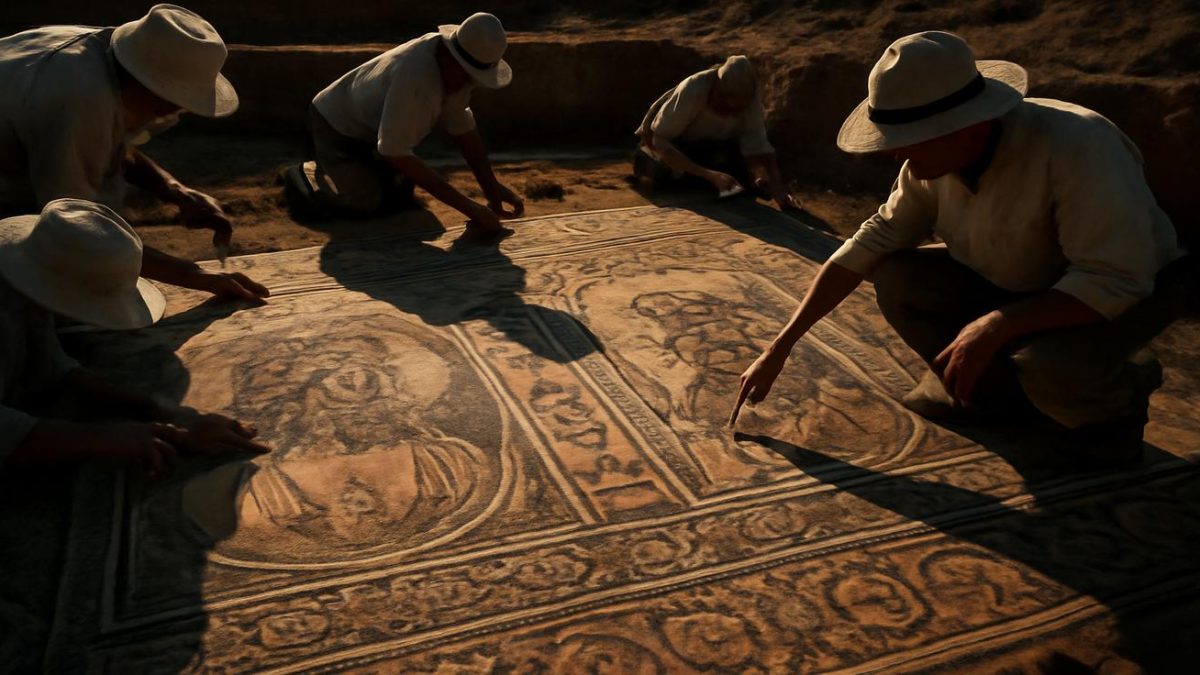
In a moment that will be etched into archaeological history, researchers have stumbled upon evidence that fundamentally reshapes our understanding of how two of antiquity’s greatest civilizations interacted. What began as a routine excavation has blossomed into one of the most significant discoveries of the decade, revealing intricate connections between Rome and Ancient Egypt that scholars never anticipated.
The Moment Everything Changed
The discovery began, as many profound moments do, with a stroke of serendipity. During an excavation in a Roman villa’s outer chambers, sunlight pierced through the protective scaffolding at just the right angle, illuminating what appeared to be fragments of an elaborately crafted mosaic. What made this discovery exceptional wasn’t merely the artistry—it was what the mosaic depicted. Woven into the geometric patterns and vibrant tiles were unmistakable Egyptian iconography and hieroglyphic symbols interspersed with Latin inscriptions.
The excavation team, led by a collaborative group of international archaeologists, immediately recognized the significance. This wasn’t a simple case of Roman merchants acquiring Egyptian artifacts. Instead, the evidence suggested a deliberate, sophisticated integration of both cultures within a single artistic work. The mosaic appeared to have been commissioned as a statement piece, a visual declaration of unity between two powerful civilizations.
Decoding the Artistic Language
What makes this discovery particularly remarkable is the level of detail preserved within the mosaic. Unlike many ancient artworks that have succumbed to time and decay, this masterpiece retained its original colors and intricate tessellation patterns. Specialists in both Roman and Egyptian art have been working tirelessly to interpret every element.
The mosaic features depictions of Nile flooding scenes alongside representations of Roman military might. Images of Egyptian deities appear alongside allegorical figures associated with Roman prosperity and abundance. This blending of mythological traditions suggests that whoever commissioned this work possessed deep knowledge of both cultures and actively sought to celebrate their interconnection.
Preliminary analysis indicates that the mosaic was created sometime during the second century CE, a period when Roman Egypt was flourishing under imperial administration. However, the artistic sophistication and the presence of specific Egyptian elements have led some scholars to propose it might be slightly earlier, potentially dating to the reign of Emperor Hadrian, known for his fascination with Egyptian culture.
Trade Routes and Cultural Exchange
Historians have long known that Rome and Egypt maintained significant economic relationships, particularly following Egypt’s conquest by Octavian in 30 BCE. However, this mosaic provides tangible evidence of something deeper—a genuine cultural synthesis occurring at the domestic level, not merely at the level of state administration or merchant activities.
The discovery suggests that wealthy Roman families invested considerable resources in acquiring not just Egyptian goods, but also in employing artisans who could authentically represent Egyptian artistic traditions. This level of cultural appreciation indicates a sophisticated appreciation extending far beyond simple material accumulation. The patron who commissioned this mosaic clearly understood both Egyptian religious symbolism and Roman aesthetic principles.
Archaeological teams are now re-examining previously excavated villas in the region with fresh perspectives. Several sites once thought to be purely Roman in character are now being reassessed for subtle Egyptian influences that may have been overlooked during earlier investigations.
Implications for Understanding Ancient Trade Networks
This discovery has reignited scholarly debates about the nature of ancient Mediterranean trade networks. While textual sources document commercial transactions, they rarely reveal the cultural impact of these exchanges. The mosaic serves as material evidence that demonstrates how trade facilitated not just economic transactions, but genuine cultural dialogue.
Scholars are particularly interested in determining where the artisans who created this mosaic received their training. Was this work produced by Egyptian craftspeople working within Roman territory? Or did Roman artisans travel to Egypt to study techniques before returning home? The answers to these questions could reshape our understanding of labor mobility and professional networks in the ancient world.
Religious and Symbolic Significance
Perhaps most intriguingly, the religious symbolism interwoven throughout the mosaic suggests something unprecedented. The careful placement of Egyptian divine figures alongside Roman religious imagery implies a deliberate attempt to create a spiritual statement celebrating the unity of both traditions. This was not accidental; it was intentional design communicating a philosophical perspective about religious tolerance or syncretism.
Some researchers propose this may have been the home of a particularly influential figure—perhaps a government official, military commander, or wealthy merchant who had spent significant time in Egypt and maintained deep personal connections there. Such individuals would have had both the resources to commission such an elaborate work and the cultural sophistication to appreciate its nuanced symbolism.
Future Research Directions
The discovery has energized the archaeological community. Teams are now conducting advanced scientific analysis, including neutron activation analysis on the tesserae (individual tiles) to determine their origins. Some tiles may have been imported directly from Egypt, while others could have been crafted locally from Egyptian-style designs.
DNA analysis of organic materials found near the mosaic site may also provide clues about the artisans and residents. Meanwhile, art historians continue cataloging every detail, creating high-resolution documentation that will serve future scholars for generations.
The implications extend beyond academic circles. This discovery reminds us that ancient civilizations were far more interconnected, more appreciative of cultural diversity, and more cosmopolitan than popular imagination often suggests. In an age of increasing nationalism and cultural division, the evidence of genuine cross-cultural appreciation demonstrated by this Roman patron resonates with contemporary sensibilities.
What began as a glint of sunlight on a forgotten corner has illuminated a new chapter in our understanding of how ancient Rome and Egypt truly related to one another—not as conquerors and conquered, not merely as trading partners, but as cultures capable of genuine mutual appreciation and artistic synthesis. This mosaic stands as a testament to the universal human capacity for appreciating beauty and meaning across cultural boundaries, a lesson as relevant today as it was two thousand years ago.










Leave a Comment