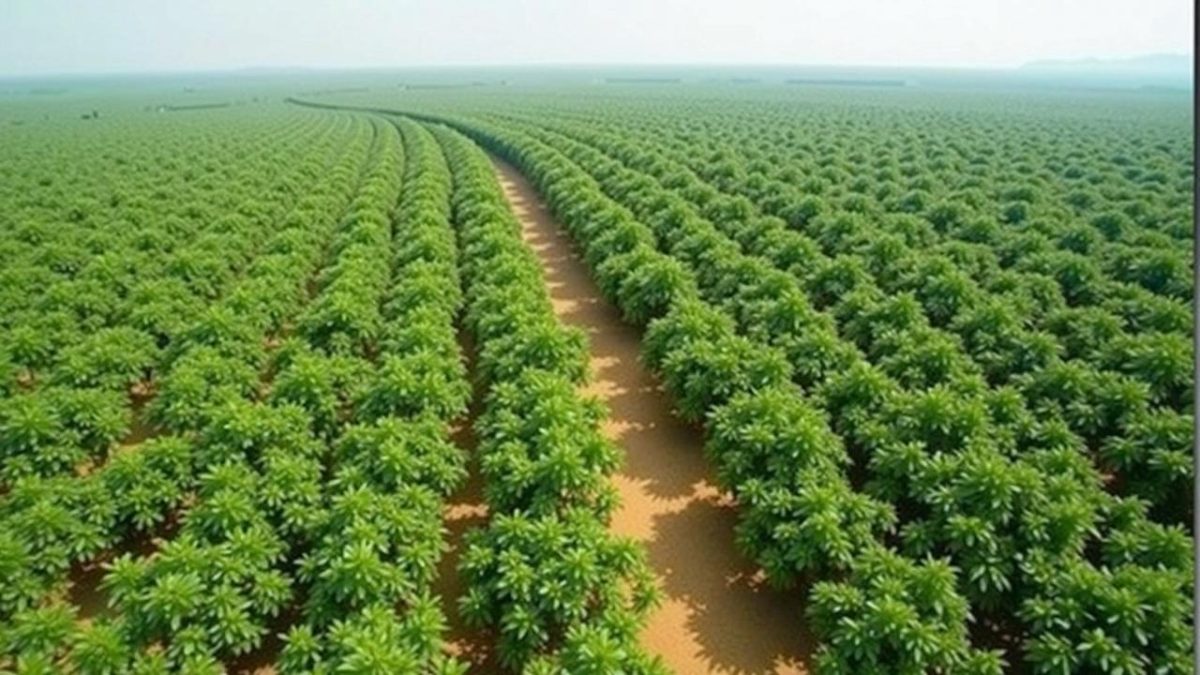
When astronauts aboard the International Space Station gaze earthward at northern China, they witness an extraordinary transformation: a verdant stripe cutting through one of Earth’s most inhospitable desert regions. This phenomenon, known as China’s Great Green Wall, represents one of the planet’s most ambitious environmental engineering projects. Yet beneath this visible success story lies a complex debate about ecological authenticity, long-term viability, and unintended consequences that could reverberate across millions of lives.
The Satellite Evidence: What NASA Sees
Recent satellite data compiled by NASA has provided compelling visual confirmation that China’s decades-long reforestation initiative is yielding measurable results. Between 2000 and 2020, thermal imaging and vegetation sensors detected a significant increase in plant coverage across regions that were previously classified as severe desert zones. The transformation is particularly pronounced in provinces like Gansu, Inner Mongolia, and Ningxia, where the greening effect has created a distinctive linear pattern visible from space.
These measurements represent concrete progress against one of China’s most pressing environmental challenges. The Gobi and other northern deserts have historically advanced southward, consuming agricultural land, burying villages, and creating respiratory hazards that affected urban centers hundreds of kilometers away. The satellite confirmation validates the substantial investment—estimated at over $100 billion—that the Chinese government has committed to this initiative since its inception in the late 1970s.
The data collection methods employed by NASA and partner institutions reveal trees planted in regimented patterns across vast territories, some spanning thousands of square kilometers. Carbon sequestration levels have increased measurably, and dust storm frequency in previously affected regions has declined noticeably, according to meteorological records analyzed alongside the satellite imagery.
On-the-Ground Reality: The Complexity Beneath the Green
However, environmental scientists who have conducted field research in these newly greened areas present a more nuanced picture than satellite imagery alone can convey. While the vegetation is undeniably present, questions linger about the ecological quality and sustainability of these planted forests.
The Great Green Wall project has predominantly relied on monoculture plantations—vast stands of a single tree species, often poplars or other fast-growing varieties selected for rapid coverage rather than ecological diversity. This approach, while effective at combating visual desert expansion, creates ecosystems that lack the complexity necessary for long-term resilience. Native species diversity in these regions remains low compared to naturally occurring forests, making these artificial woodlands vulnerable to disease, pest infestations, and climate stress.
Furthermore, many plantations established in the project’s early phases have experienced high mortality rates. Independent surveys suggest that survival rates in some areas drop below 50%, meaning that substantial portions of the green visible from space may be largely empty space between scattered surviving trees rather than dense, functional forests. Maintenance and replanting efforts have been inconsistent, with funding and attention fluctuating based on political priorities and economic circumstances.
The Water Crisis: Hidden Ecological Costs
Perhaps the most significant criticism concerns water resource depletion. Northern China’s semi-arid and arid regions have limited and variable water supplies, with many areas depending on groundwater reserves that took centuries to accumulate. The newly planted forests require substantial irrigation, particularly during their establishment phases, placing enormous strain on these finite resources.
Hydrological studies indicate that some areas have experienced significant groundwater level declines directly attributable to irrigation demands from reforestation projects. In certain regions, wells have needed to be dug progressively deeper, and some communities have experienced reduced water availability for agricultural and domestic purposes. This creates a troubling paradox: the solution to one environmental problem—desertification—is exacerbating another—water scarcity—that affects millions of residents in these economically disadvantaged regions.
Agricultural communities that have existed in these borderlands for generations face mounting pressure as water competition intensifies. Farmers report declining well yields and increased costs for water extraction, threatening the viability of traditional livelihoods and accelerating rural-to-urban migration.
Climate Adaptation or Ecological Mirage?
Critics characterize the Great Green Wall as potentially representing an “ecological mirage”—a visually impressive intervention that addresses surface-level symptoms while neglecting underlying causes and creating new problems. The project assumes that desertification results primarily from insufficient vegetation, when in reality, complex interactions between climate patterns, water availability, soil composition, and human land use practices drive the phenomenon.
Climate projections for northern China suggest increasing temperatures and potentially shifting precipitation patterns. Some scientists question whether the planted forests can maintain their current coverage under these changing conditions without ever-increasing irrigation inputs. The long-term viability of the project depends on assumptions about future climate stability that may not materialize.
Additionally, the focus on rapid plantation establishment has sometimes come at the expense of understanding and restoring natural ecological processes. Some regions might recover more effectively through adjusted grazing practices, native species regeneration, and water conservation strategies rather than intensive tree-planting programs.
The Path Forward: Balancing Ambition with Realism
The Great Green Wall’s ultimate success or failure will depend on adaptations to current strategies. Environmental experts increasingly advocate for approaches that emphasize ecological quality over mere coverage expansion, prioritize native species diversity, implement careful water resource management, and integrate traditional ecological knowledge with modern environmental science.
The satellite evidence that confirms greening across northern China represents genuine progress against desert expansion, but this progress must be contextualized within broader environmental and social impacts. Future conservation efforts in these regions should pursue strategies that can sustain themselves within existing ecological constraints rather than relying on intensive inputs that may prove unsustainable.
China’s Great Green Wall demonstrates both the potential and limitations of large-scale environmental engineering. The visible transformation visible from space inspires hope, yet ground-level realities suggest that sustainable restoration requires approaches far more sophisticated than planting trees across deserts, no matter how many satellites confirm their presence.







Leave a Comment