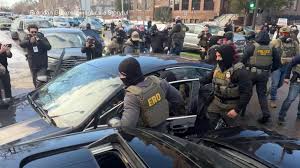
As of Thursday, January 15, 2026, multiple major outlets reported that President Donald Trump warned he may invoke the Insurrection Act in Minnesota amid escalating protests tied to federal immigration enforcement activity in Minneapolis and surrounding areas.
The comments instantly lit up social media (especially Reddit), because the Insurrection Act is one of the most extreme legal tools available to a U.S. president: it can allow federal deployment of the military or federalized National Guard for domestic law enforcement under specific conditions.
Below is a detailed, Reddit-and-NewsBreak-friendly breakdown of what’s happening, why it matters, what’s confirmed vs disputed, and what to watch next.
What’s the latest (as of January 15–16, 2026)?
Here’s what major reporting agrees on:
-
Protests have continued in Minneapolis in response to a surge of federal immigration enforcement operations.
-
The situation intensified after two shooting incidents involving federal immigration enforcement were reported in the same week, including the fatal shooting of Renee Good (reported by AP/Reuters/Guardian).
-
Trump publicly threatened to use the Insurrection Act if unrest persists or if local/state leaders “fail” to control the situation (language varies by outlet, but the threat is consistent).
-
Minnesota leaders, including Gov. Tim Walz and AG Keith Ellison, have pushed back—signaling legal challenges and warning against escalation.
-
Civil liberties groups, including the ACLU of Minnesota, have filed legal action alleging unconstitutional enforcement practices.
One detail that is heavily reported but still politically contested is the scale and conduct of the federal operation. AP reports “Operation Metro Surge,” including 2,000 ICE agents deployed since early January and 2,500+ arrests; Minnesota officials dispute aspects and raise constitutional concerns.
Why this is blowing up online
The phrase “Insurrection Act” hits like a siren because it’s historically rare and emotionally loaded. Most Americans associate it with moments when the federal government takes extraordinary steps to restore order—or to enforce rights—during crisis-level unrest.
When a president even talks about invoking it, people immediately jump to big questions:
-
Is this a public safety response—or political theater?
-
Would troops be used against protesters?
-
Who decides what counts as “insurrection”?
-
Could it chill free speech or lawful protest?
That’s why the story is trending in political communities and local subreddits: it’s not just about Minnesota—it’s about federal power.
What is the Insurrection Act ?
The Insurrection Act (1807) is a U.S. law that allows a president to deploy federal troops and/or federalize the National Guard inside the United States under certain circumstances, such as suppressing civil disorder, enforcing federal law, or protecting constitutional rights when states are unable or unwilling to do so.
It’s often discussed alongside the Posse Comitatus Act, which generally limits the military from doing domestic policing. The Insurrection Act is one of the major exceptions that can unlock domestic military involvement.
When was it last used?
Multiple explainers note the most recent invocation was in 1992, during the Los Angeles riots.
What Trump is signaling — and what he can actually do
Trump’s threat matters because it’s not merely rhetorical: a sitting president can try to invoke the Act, and courts often move slower than events on the ground.
That said, invoking it is not automatic, and it’s politically explosive—especially if state leaders oppose federal intervention.
Reporting frames Trump’s message as a “law-and-order” posture in response to protests linked to immigration raids and the fallout from the shootings.
What Minnesota officials and critics are saying
Minnesota leaders are essentially arguing two things:
-
The federal response is intensifying the situation, not calming it.
-
Constitutional lines may be getting crossed, especially regarding detention practices and alleged profiling.
AP reports that AG Keith Ellison has threatened legal challenges, while the ACLU lawsuit alleges unlawful actions such as racial profiling and unlawful detentions.
National political reaction has also been sharp. The Washington Post reported condemnation from Minnesota’s congressional Democrats, with concerns framed in unusually strong language.
What federal officials are saying
Federal officials have defended the enforcement surge as necessary, citing violence and threats to officers. Reuters reports DHS emphasizing an ongoing security rationale, and AP reports the administration describing protests and clashes as justification for escalation.
However, some key incident details remain disputed in reporting—particularly around the second shooting narrative and what exactly occurred in the confrontation leading to it. Reuters explicitly notes parts of the federal account were not independently verified.
Timeline: how this spiraled fast
Based on current reporting, the sequence looks like this:
-
Early January 2026: Federal immigration enforcement surge begins in Minneapolis (AP calls it “Operation Metro Surge”).
-
Mid-January: Fatal shooting of Renee Good reported during ICE-related events; protests swell.
-
Same week: Second shooting incident reported involving an immigration officer and a man; protests intensify and clashes continue.
-
January 15, 2026: Trump threatens invoking the Insurrection Act.
Why the Insurrection Act threat is a big deal legally and politically
Even when it’s not invoked, the threat itself can shift reality on the ground:
-
It can raise tensions (protesters may fear escalation; police may prepare differently).
-
It can change behavior (people may avoid lawful protest due to fear of force).
-
It can pressure local leaders into decisions under duress.
-
It can set precedent for how future unrest is framed and handled.
Legal analysts interviewed in major outlets have warned that invoking it in a protest context—especially without state request—would be extraordinary and potentially destabilizing.
What to watch next
If this story continues to develop, these are the signals that matter:
-
Any formal legal step (White House memo, DOJ legal justification, or proclamation language).
-
Court action (ACLU filings, state lawsuits, emergency injunctions).
-
Guard/military posture changes (federalization vs state-controlled deployments).
-
Independent verification of disputed incident details.
-
Local conditions (whether protests remain peaceful, whether clashes spread, whether curfews or emergency orders expand).
FAQ
1) Did Trump invoke the Insurrection Act in Minnesota?
As of reporting published January 15, 2026, Trump threatened or signaled he may invoke it, but major coverage describes it as a threat, not confirmed invocation.
2) What would happen if the Insurrection Act is invoked?
It could allow the president to deploy federal troops and/or federalize the National Guard for domestic operations under specific legal conditions.
3) Has the Insurrection Act been used before?
Yes. It has been used at various points in U.S. history, including during civil rights-era enforcement actions. Many explainers cite the last use in 1992 (LA riots).
4) Why are protests happening in Minneapolis?
Reporting ties protests to a federal immigration crackdown and the fallout from shooting incidents involving federal immigration enforcement, including the reported fatal shooting of Renee Good.
5) Are details of the incidents confirmed?
Some elements are reported consistently (that shootings occurred and protests followed), but parts of the second incident’s account are described as not independently verified in reporting.
6) Is Minnesota taking legal action?
AP and other reports say Minnesota officials signaled legal challenges, and the ACLU of Minnesota filed suit alleging constitutional violations.





Leave a Comment