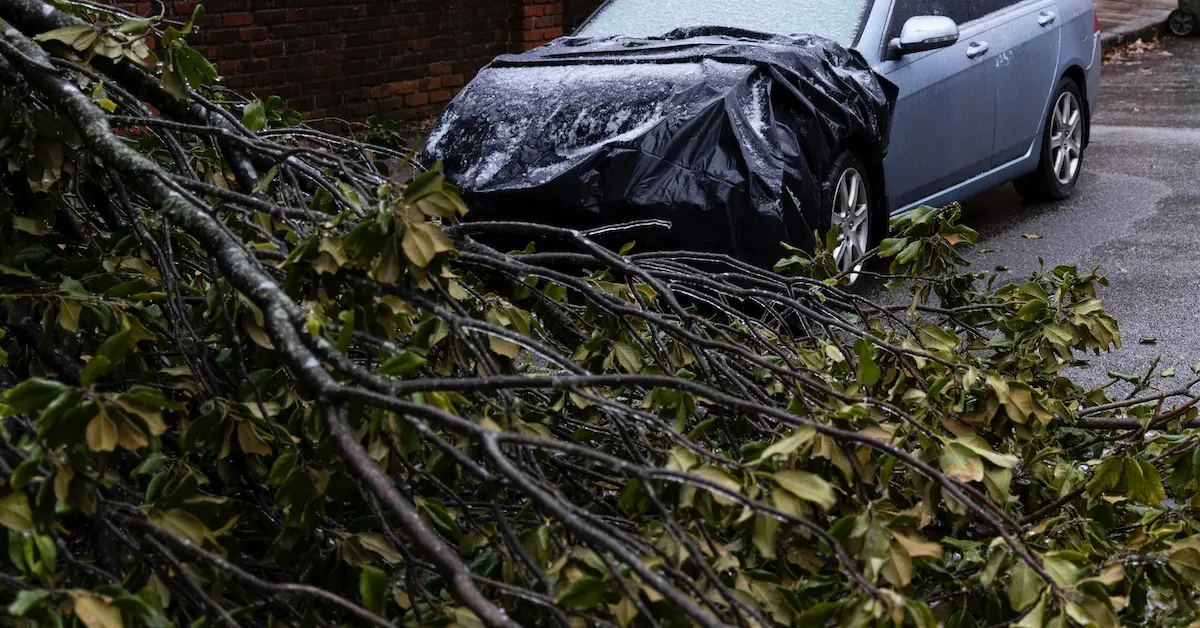
Social media posts warning about “exploding trees” have surged during recent cold snaps, alarming residents across several states.
The phenomenon gained renewed attention Thursday morning on Virginia Tech’s campus, where a sweet cherry tree was found split open after freezing temperatures.
John Seiler, a professor and tree physiology specialist at Virginia Tech, said the damage was not caused by an explosion but by extreme cold stressing the tree’s internal structure.
As winter cold intensifies across much of the country, experts say understanding this natural process is important to avoid confusion and unnecessary concern.
WHAT ARE ‘EXPLODING TREES’?
Despite the dramatic name, trees are not actually exploding.
The term refers to trees that crack or split when exposed to rapid temperature drops, especially during intense winter cold.
When water inside a tree freezes, it expands, placing pressure on the trunk and internal tissues.
If that pressure becomes too great, the wood can split suddenly, often producing a loud cracking sound that leads people to believe something exploded.
DISCOVERY ON VIRGINIA TECH CAMPUS
The latest example was discovered Thursday morning in Blacksburg, Virginia.
John Seiler was walking across Virginia Tech’s campus with his students when they noticed a sweet cherry tree bearing a long, jagged scar down its trunk.
Seiler said the damage was immediately recognizable.
“The tree had broken open in the cold,” he explained, noting that such splits are a known response to freezing conditions.
BACKGROUND: WHY WINTER WEATHER CAUSES TREE SPLITTING
Trees contain water throughout their living tissues, particularly just beneath the bark.
During extreme cold, this water freezes and expands.
At the same time, the outer layers of the tree contract faster than the inner wood.
This imbalance creates stress that can cause the trunk to crack, especially when temperatures drop rapidly overnight.
The process is often referred to by arborists as frost cracking or winter splitting.
WHICH TREES ARE MOST VULNERABLE
Not all trees are equally affected by winter splitting.
Thin-barked trees such as cherry, maple, sycamore, and birch are more susceptible.
Young trees and recently planted trees face a higher risk because their bark and root systems are less developed.
Trees already stressed by drought, disease, or poor soil conditions are also more likely to split during extreme cold.
TIMELINE: WHEN TREE SPLITTING TYPICALLY OCCURS
Sudden Cold Snaps
Tree splitting often follows rapid temperature drops after mild or above-average weather.
Overnight Freezes
Many splits occur late at night or early morning when temperatures reach their lowest point.
Freeze-Thaw Cycles
Repeated warming and freezing can worsen existing cracks or reopen old ones.
Experts say winter splitting is most common during prolonged Arctic outbreaks.
DOES TREE SPLITTING POSE A SAFETY RISK?
In most cases, tree splitting does not pose an immediate danger to people.
The cracking sound can be startling, but it usually does not involve branches breaking or falling.
However, deep or repeated splits can weaken a tree’s structure over time.
Trees near homes, sidewalks, or roadways should be monitored for signs of instability.
Local arborists can assess whether damaged trees require pruning or removal.
OFFICIAL EXPERT EXPLANATION
Seiler emphasized that winter splitting is a mechanical response to cold, not a sign of disease or insect infestation.
He noted that many trees are capable of surviving these injuries.
As temperatures warm, some cracks may partially close as the tree resumes growth.
Others may remain visible but not necessarily threaten the tree’s long-term health.
Experts advise against sealing cracks with paint or tar, as this can trap moisture and cause further damage.
PUBLIC REACTION AND VIRAL CONFUSION
Images and videos of split trees have circulated widely on social media, often labeled as “tree explosions.”
Some users reported hearing loud cracking sounds overnight and mistaking them for gunshots or structural damage.
Forestry experts say the viral terminology has fueled unnecessary fear.
They stress that the phenomenon is natural and has occurred for centuries in cold climates.
WHAT HOMEOWNERS SHOULD AND SHOULD NOT DO
Experts recommend leaving most cracks alone.
Trees have natural defenses that allow them to compartmentalize damage.
Mulching around the base of trees can help regulate soil temperature and reduce stress.
Wrapping young trees with protective guards may help prevent future splits.
For severe damage or trees near structures, consulting a certified arborist is advised.
WHAT HAPPENS NEXT AS WINTER CONTINUES
As cold weather persists across much of the U.S., additional cases of tree splitting are likely.
Experts expect reports to increase during periods of extreme temperature swings.
Monitoring trees through the remainder of winter and into early spring is important.
Spring growth will help determine whether a tree has recovered or requires professional intervention.
KEY FACTS SUMMARY
| Category | Details |
|---|---|
| Event | Winter tree splitting (“exploding trees”) |
| Location | Virginia Tech campus, Virginia |
| Date | Thursday morning |
| Who Is Affected | Trees, homeowners, property managers |
| Current Status | Cold-related tree damage observed |
| What Readers Should Know | Caused by freezing temperatures, not explosions |
FREQUENTLY ASKED QUESTIONS
What causes “exploding trees”?
Rapid freezing causes internal pressure that splits the tree’s trunk.
Do trees actually explode?
No. The loud noise comes from cracking wood, not an explosion.
Which trees are most at risk?
Thin-barked trees like cherry, maple, and birch are most vulnerable.
Can trees survive after splitting?
Many trees recover and continue growing after minor splits.
Should cracks be sealed or filled?
Experts advise against sealing cracks, as it can cause further damage.
Is this related to extreme weather?
Yes. Sudden temperature drops and prolonged cold increase the risk.
CLOSING
The split tree spotted at Virginia Tech highlights how extreme winter cold can affect even healthy trees.
While the phrase “exploding trees” may sound alarming, experts say the process is a well-understood response to freezing temperatures.
As winter weather continues, residents are encouraged to stay informed and monitor trees for signs of stress or damage.







Leave a Comment