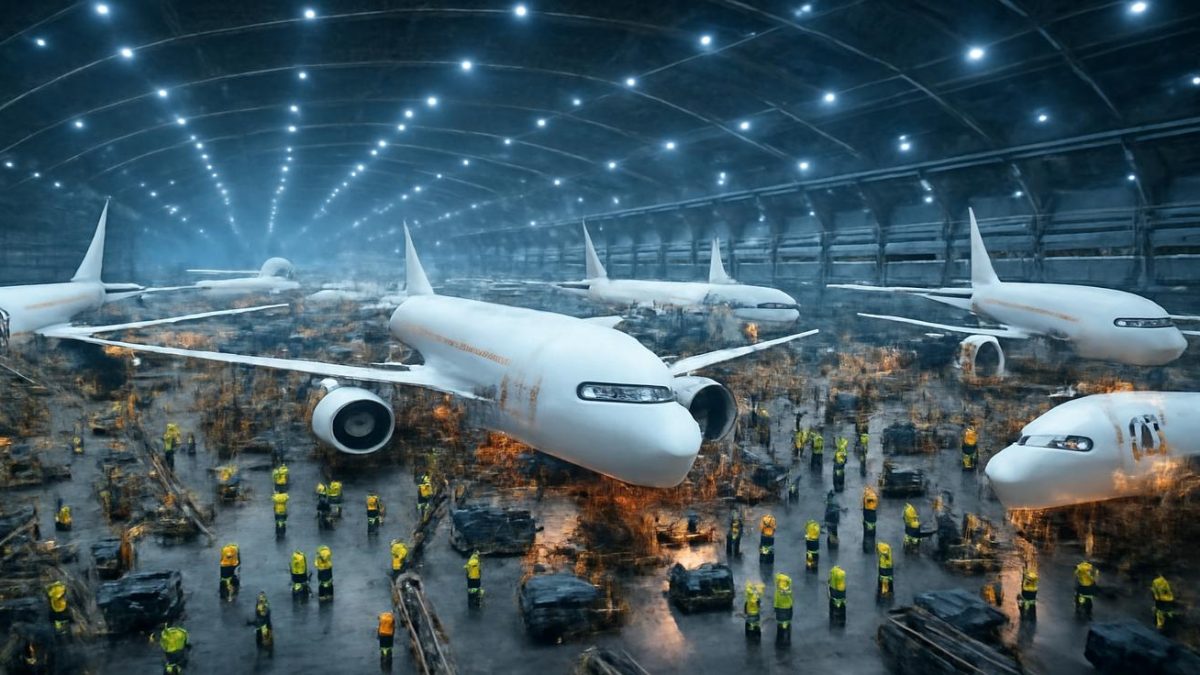
When you step into one of the world’s largest manufacturing facilities dedicated to aircraft production, you’re entering a world of unprecedented scale and coordination. With 30,000 employees working across an expanse so enormous that a simple walk from one end to the other consumes fifteen minutes, this industrial giant represents the pinnacle of modern manufacturing capability. The facility’s most impressive feat: the simultaneous assembly of eight commercial aircraft, a logistical achievement that demands extraordinary precision, planning, and human coordination.
The Sheer Scale of Industrial Might
Understanding the magnitude of this facility requires context. To put it simply, the building covers an area comparable to several hundred football fields combined. The infrastructure required to support such an operation extends far beyond the visible factory floor. Climate control systems maintain optimal conditions across millions of square feet, while electrical grids supply enough power to service a small city. The logistics alone—managing materials, components, and workers across such vast distances—present engineering challenges that would have seemed impossible just decades ago.
The architectural design of this facility represents decades of accumulated manufacturing knowledge. Every corridor, every production line, and every assembly station has been strategically positioned to maximize efficiency. The building itself is as much a marvel of engineering as the aircraft being produced within it. High ceilings accommodate massive machinery and overhead conveyance systems, while the floor plan has been optimized to minimize unnecessary movement and maximize workflow continuity.
Orchestrating 30,000 Human Resources
The employment of thirty thousand workers represents a small city’s worth of human resources, all working toward a singular purpose: building advanced aircraft. Managing such a workforce requires unprecedented levels of coordination and communication. Shift schedules must be carefully orchestrated to ensure continuous production while allowing for maintenance and quality checks. Training programs need to accommodate thousands of new employees annually, transferring specialized knowledge from experienced technicians to the next generation.
The diversity of roles within this facility is remarkable. Engineers design and refine production processes, welders join fuselage sections with precision, electricians install complex avionics systems, and quality inspectors verify that every component meets exacting standards. Logistics specialists manage the flow of materials, while supervisors ensure teams stay coordinated. The hierarchy of communication must function flawlessly; a miscommunication in one section could cascade through the entire operation, affecting schedules for multiple aircraft.
Eight Simultaneous Assemblies: A Coordinated Dance
Perhaps the most impressive capability of this facility is its ability to assemble eight commercial aircraft at the same time. This isn’t simply a matter of having enough space—it requires a fundamentally different approach to manufacturing than traditional assembly lines. Multiple production tracks run parallel to each other, each handling different stages of aircraft assembly simultaneously. Materials must be coordinated precisely so that the right components arrive at the right assembly station at exactly the right moment.
The simultaneous assembly of multiple aircraft demands sophisticated scheduling systems. Computer networks track thousands of individual components, coordinating their movement from warehouse to assembly station. Robotic systems work alongside human craftspeople, performing repetitive tasks with mechanical precision while humans handle the complex, judgment-based work that machines cannot yet replicate effectively. The synchronization between human workers and automated systems represents a blend of analog and digital manufacturing at its finest.
Supply Chain Mastery
Feeding a production operation capable of building eight aircraft simultaneously requires an supply chain of almost incomprehensible complexity. Thousands of individual components must arrive daily, each tracked and verified for quality before entering the assembly process. Suppliers from around the globe contribute specialized parts—engines from certain manufacturers, avionics from others, structural materials from yet more specialized producers. Coordinating this global supply network to keep production flowing without interruption represents its own engineering challenge.
The facility maintains careful inventory management, balancing the need for adequate supplies against storage limitations and the risk of components becoming obsolete. Just-in-time manufacturing principles are employed wherever possible, reducing waste and minimizing warehouse requirements. Quality control checkpoints are distributed throughout the supply chain, catching defects before they reach the production floor where they would be exponentially more expensive to remediate.
Technological Innovation in Production
The manufacturing processes employed within this facility incorporate cutting-edge technology. Automated systems handle welding, fastening, and component placement with tolerances measured in fractions of millimeters. Advanced robotics work tirelessly on repetitive tasks, freeing human workers to focus on complex assembly and quality verification. Computer vision systems inspect components for defects invisible to human eyes, while advanced testing equipment validates the performance of integrated systems before aircraft leave the facility.
The facility continuously evolves, incorporating new technologies to improve efficiency and quality. 3D printing is increasingly used to produce specific components, reducing material waste and lead times. Augmented reality systems assist workers, providing real-time guidance and technical information. Artificial intelligence analyzes production data, identifying bottlenecks and optimizing workflows. The facility functions as a living laboratory for manufacturing innovation.
Quality and Safety Standards
Aircraft production demands uncompromising quality standards. Every aircraft that leaves this facility will carry hundreds of passengers at thirty-five thousand feet. The responsibility this creates permeates every aspect of operations. Extensive testing protocols validate every component and system. Redundant quality checkpoints catch errors before they propagate further. Workers receive rigorous training in safety protocols and quality procedures, understanding that their attention to detail literally saves lives.
Safety within the facility extends beyond the products being built to protecting the workers themselves. Operating in such a massive facility with heavy machinery, high altitudes, and complex processes presents inherent risks. Comprehensive safety programs, protective equipment, and training initiatives work to minimize workplace incidents. The facility maintains sophisticated accident prevention systems and emergency response capabilities.
The Future of Large-Scale Manufacturing
This facility represents not just current manufacturing capability but a blueprint for industrial operations of the future. As demand for commercial aircraft continues growing, facilities of this scale may become increasingly common. Automation advances will likely increase the role of robots, but human expertise will remain irreplaceable for complex assembly, quality control, and problem-solving. The facility’s scale offers efficiency advantages that smaller operations cannot match, driving continued consolidation in high-technology manufacturing sectors.
The existence and success of this massive production facility demonstrates humanity’s capacity for organization, coordination, and achievement at an extraordinary scale. It stands as a testament to what becomes possible when engineering expertise, advanced technology, and thousands of dedicated workers focus on a common mission. In an era of increasing global connectivity and technological capability, facilities like this represent the cutting edge of what human industry can accomplish.









Leave a Comment