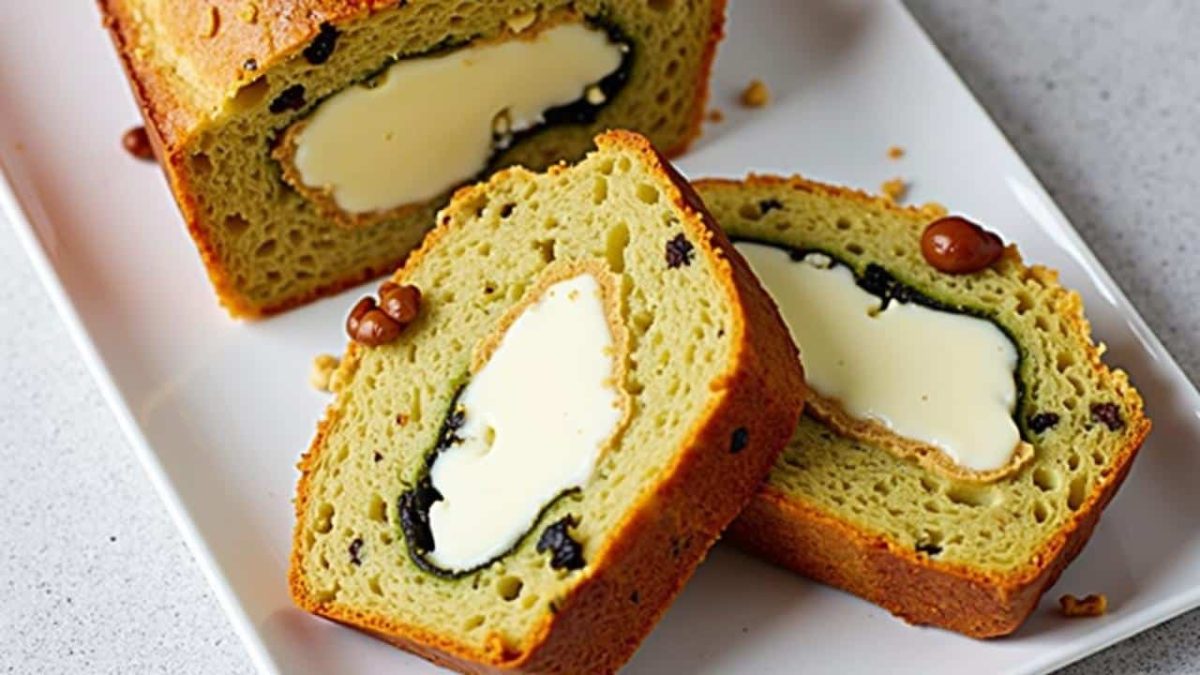
There’s a quiet revolution happening in French kitchens, and it doesn’t involve the traditional quiche that’s dominated our dinner tables for decades. Instead, home cooks are reaching for a far simpler, remarkably more indulgent creation: a savory loaf studded with creamy blue cheese and crunchy walnuts that emerges from the oven golden, fragrant, and absolutely irresistible.
Why This Loaf Outshines the Classic Quiche
For generations, quiche has held its throne as the go-to French savory dish. It’s elegant, versatile, and undeniably delicious. But quiche demands respect. It requires blind baking, careful temperature management, custard precision, and usually a full hour of your time. Then there’s the cleanup—mixing bowls, measuring equipment, and the inevitable splattered stovetop.
The blue cheese and walnut loaf throws caution to the wind. It’s what happens when French culinary tradition meets modern impatience, and honestly, nobody’s complaining. The beauty lies in its simplicity: you’re essentially doctoring a basic bread dough with luxurious additions, then watching magic happen in your oven.
What makes it genuinely more indulgent than quiche? The answer lies in cheese-to-bite ratio. Where quiche distributes its filling evenly throughout the custard, this loaf concentrates pockets of melting Fourme d’Ambert throughout dense, rich crumb. Each slice offers surprise bursts of creamy, pungent blue cheese that’s been gently warmed into submission, becoming almost butter-like in texture. The walnuts add earthy sophistication and textural contrast that keeps things from becoming one-dimensional.
Understanding Fourme d’Ambert: The Secret Weapon
You might be wondering why Fourme d’Ambert specifically? It’s not snobbery—it’s strategy. This French blue cheese, hailing from the Auvergne region, occupies a sweet spot between aggressive and approachable. Unlike Roquefort’s assertive punch, Fourme d’Ambert offers minerality and subtle nuttiness that complements rather than dominates.
When baked into bread, it doesn’t separate or become oily. Instead, it melts into creamy rivers throughout the loaf, creating pockets of rich indulgence without overwhelming the palate. The natural fungi in blue cheese also interact with the bread’s yeast during baking, creating subtle flavor development that homogeneous cheeses simply cannot achieve.
That said, if Fourme d’Ambert isn’t available in your local shops, don’t despair. A good Stilton, Gorgonzola, or even a quality Danish blue will work admirably. The principle remains unchanged: use a blue cheese with enough character to matter, but enough subtlety to play well with others.
The Walnut Partnership
Walnuts aren’t just a textural add-on here—they’re essential to the flavor architecture. Their slight bitterness creates counterpoint to the cheese’s richness, while their oils lend additional depth to the crumb. Toasting them before incorporation intensifies these qualities.
The walnut-cheese combination isn’t arbitrary either. This pairing appears throughout French charcuterie boards and traditional cheese courses for good reason. In bread form, they transform from appetizer components into an integrated whole, each element enhancing what comes before.
The Recipe That Changes Everything
Here’s what makes this loaf truly revolutionary: most people can make it with ingredients they already possess. You need all-purpose flour, yeast, salt, water—foundational bread-making supplies—plus your blue cheese and walnuts.
Begin with a standard bread dough. Combine 500g flour with 7g instant yeast, 10g salt, 325ml warm water, and let it bulk ferment for two to four hours until doubled. Meanwhile, crumble 150g of Fourme d’Ambert into rough chunks and roughly chop 100g of toasted walnuts.
After bulk fermentation, turn the dough onto a lightly floured surface. Gently fold in your cheese and walnuts, being careful not to overwork the dough—you want pockets, not even distribution. Shape into a round or oval, place on parchment paper, and let it undergo final proof for 45 minutes to an hour.
Score the top dramatically with a sharp knife, then bake in a preheated 450°F oven for 35-40 minutes until golden brown and your kitchen smells like a Parisian bakery crossed with a cheese monger’s fever dream.
The crust will crackle and sing. The interior will be tender, with actual structure—not the custard-dependent crumb of quiche. Every bite offers unexpected pockets of melted cheese, providing that element of surprise and indulgence that makes a recipe worth repeating.
Why It’s a Repeat Recipe
The reason this loaf finds itself cycling through kitchens on constant repeat is straightforward: it delivers disproportionate satisfaction relative to effort invested. From mixing bowl to table, you’re looking at approximately four to five hours total, but active hands-on time? Perhaps twenty minutes.
It’s also remarkably forgiving. Unlike quiche, which can crack and separate if you breathe wrong, this bread is resilient. Over-proof it slightly? It still rises beautifully. Underbake by a few minutes? The residual heat will finish the job. Skip the fancy shaping? A rustic, lumpy loaf tastes identical to something you’d photograph for Instagram.
Beyond ease, there’s versatility. Serve it warm with cultured butter at dinner. Toast yesterday’s slices for breakfast. Crumble it into salads. Pair it with wine and charcuterie. It transcends the single-purpose quality that sometimes plagues quiche.
The Verdict
French culinary tradition teaches us that complexity requires dedication. This loaf respectfully disagrees. It proves that indulgence and accessibility can coexist beautifully. It’s a recipe that makes you feel like you’ve accomplished something sophisticated when really, you’ve simply combined ingredients and trusted fermentation and heat to do the heavy lifting.
Once you’ve made this loaf once, you’ll understand immediately why it’s becoming the whispered favorite in French home kitchens. It’s not replacing quiche—there’s room on the table for both. But this blue cheese and walnut creation? It might just earn the starring role you’ve reserved for your most-repeated recipes.









Leave a Comment