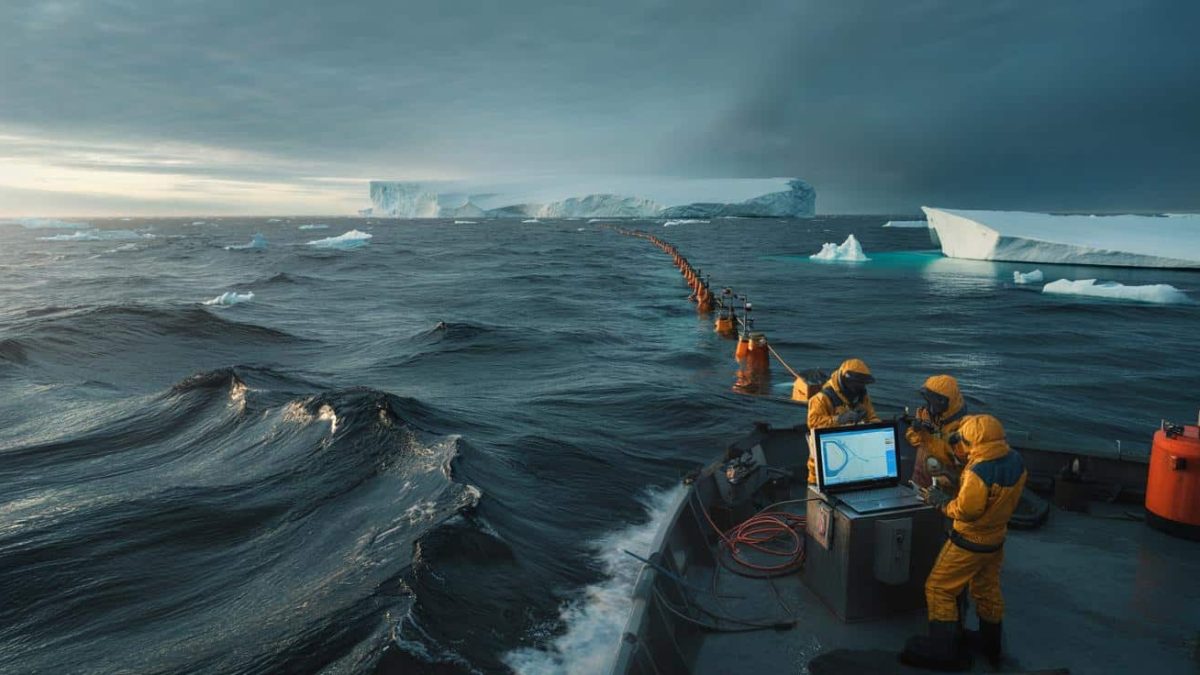
In what scientists are calling a watershed moment for climate science, the Antarctic Circumpolar Current—a colossal oceanic force that has flowed in the same direction for millennia—has reversed course. This unprecedented event, documented for the first time in recorded history, represents far more than a mere curiosity in oceanography. It signals a fundamental disruption in the mechanisms that regulate our planet’s climate, weather systems, and the delicate balance of life in our oceans.
Understanding the Antarctic Circumpolar Current
Before we can grasp the significance of this reversal, we need to understand what the Antarctic Circumpolar Current actually is. This massive ocean current encircles Antarctica, flowing from west to east around the frozen continent. Think of it as an oceanic superhighway, pushing approximately 130 million cubic meters of water per second—more water than all the world’s rivers combined. This makes it not just powerful, but absolutely fundamental to how our planet’s climate engine operates.
The current serves several critical functions. It acts as a thermal regulator, distributing heat across the Southern Hemisphere. It facilitates nutrient cycling that sustains the base of the marine food web. It influences atmospheric circulation patterns that affect weather thousands of miles away. For hundreds of thousands of years, this current has maintained its consistent eastward flow, driven by wind patterns and the Coriolis effect, creating a stable framework upon which countless biological and meteorological systems depend.
The Unprecedented Reversal Event
Recent monitoring by oceanographic institutions revealed that this long-established pattern has fundamentally changed. The current’s flow has reversed direction, moving westward instead of its traditional eastward movement. While temporary fluctuations in ocean currents do occur naturally, a sustained reversal of this magnitude represents something entirely different—a potential tipping point in Earth’s climate system.
What makes this development particularly alarming is that it wasn’t predicted by most climate models. Scientists had theorized about the possibility under extreme warming scenarios, but the speed and timing of this reversal has caught even pessimistic researchers off guard. The event occurred approximately a decade ahead of projections made just fifteen years ago, suggesting that our understanding of climate tipping points may still be incomplete.
Contributing Factors Behind the Shift
Multiple interconnected factors have contributed to this unprecedented reversal. Climate change has accelerated warming in the Southern Ocean at rates faster than global averages. This temperature increase affects water density, which in turn influences current dynamics. Simultaneously, changes in wind patterns around Antarctica—partially attributable to ozone recovery but also to broader atmospheric circulation changes—have altered the driving forces behind the current.
Freshwater influx from accelerating ice sheet melt around Antarctica has also played a role. As massive ice shelves break apart and glaciers discharge meltwater into the Southern Ocean, they alter the salinity and temperature profiles that historically maintained the current’s eastward flow. These factors don’t act in isolation; instead, they compound and amplify each other in complex feedback loops that oceanographers are still working to fully understand.
Cascading Consequences for Global Climate
The implications of a reversed Antarctic Circumpolar Current extend far beyond the Southern Ocean. This current is one of the critical pillars of Earth’s climate regulation system, and disrupting it creates ripple effects across the entire planet. Changes in how water circulates around Antarctica directly influence heat distribution in the Southern Hemisphere, which subsequently affects Northern Hemisphere weather patterns through atmospheric connections.
The reversal threatens to disrupt nutrient upwelling processes that have sustained some of the world’s most productive marine ecosystems. Antarctic krill, which form the foundation of the Southern Ocean food web, depend on specific nutrient conditions. Changes to these conditions could devastate populations of whales, seals, penguins, and fish species that depend on krill for survival. The economic implications for fishing industries and tourism in regions dependent on these ecosystems could be substantial.
Additionally, the reversed current may alter how the Southern Ocean absorbs and stores heat and carbon dioxide. For decades, this region has acted as a crucial carbon sink, absorbing excess greenhouse gases produced by human activities. A fundamental change in current direction could reduce this absorption capacity, creating a positive feedback loop where more CO2 remains in the atmosphere, accelerating warming, which further disrupts ocean circulation.
What This Means for Weather and Climate Predictions
Meteorologists and climate scientists are now scrambling to reassess their models and predictions. Weather patterns across the Southern Hemisphere—affecting South America, southern Africa, Australia, and New Zealand—could shift in unexpected ways. Storm formation, rainfall distribution, and temperature variations may deviate from historical patterns that societies have adapted to over generations.
The reversal also raises urgent questions about other ocean currents. The Atlantic Meridional Overturning Circulation, which includes the Gulf Stream, has already shown signs of weakening. The potential for similar reversals in other critical currents cannot be dismissed. We may be witnessing the early stages of a fundamental reorganization of Earth’s ocean circulation system.
Research and Monitoring Initiatives
In response to this crisis, oceanographic institutions worldwide have intensified monitoring efforts. Advanced satellite technology, autonomous underwater vehicles, and network arrays of sensors are providing unprecedented real-time data about Southern Ocean conditions. Scientists hope that continuous monitoring will help predict whether this reversal will stabilize, reverse again, or trigger additional catastrophic changes.
The Broader Climate Emergency Context
This reversal cannot be separated from the larger context of anthropogenic climate change. It represents tangible evidence that human-induced warming is pushing Earth’s systems beyond their historical operating parameters. While some might view a single reversal as a natural variation, the speed at which it occurred and its alignment with climate change predictions suggests otherwise.
What We Must Do Now
The Antarctic Circumpolar Current reversal serves as a stark reminder that we cannot treat climate change as an abstract future threat. The consequences are manifesting now, in ways that were considered distant possibilities just years ago. Accelerating emissions reduction efforts, investing in renewable energy infrastructure, and supporting climate adaptation strategies are no longer optional—they are imperative responses to an unfolding crisis.
This unprecedented oceanic event should catalyze immediate global action on climate policy, corporate responsibility, and individual choices. The systems keeping our planet habitable are being pushed to their limits, and we have limited time to reverse course.










Leave a Comment