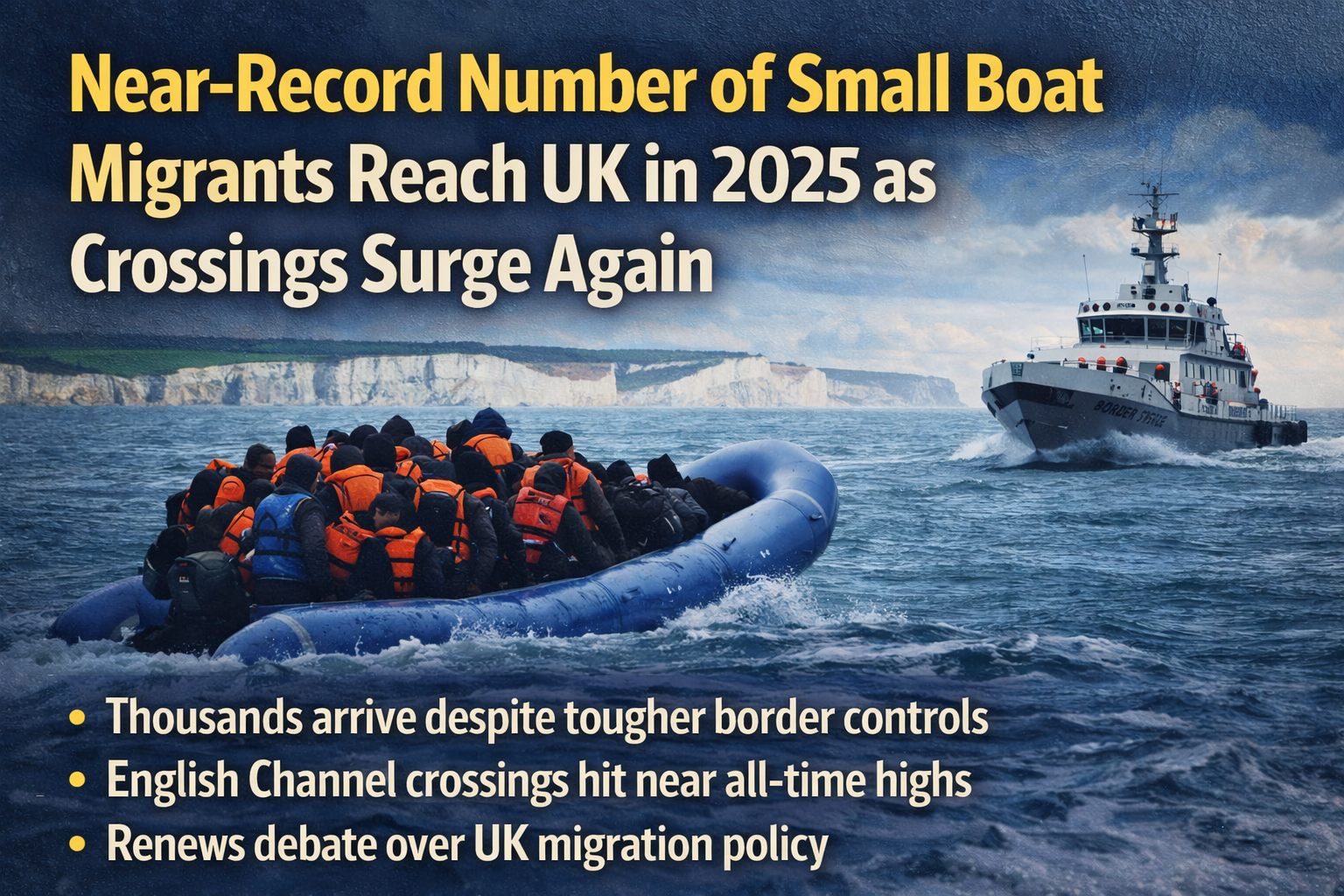
The number of migrants arriving in the UK via small boats across the English Channel reached near-record levels in 2025, according to provisional figures and tracking data, reigniting one of the country’s most divisive political and humanitarian debates. Despite tougher border rhetoric, increased patrols, and new legislation, crossings continued at scale—underscoring the complexity of stopping irregular migration routes that span multiple countries and criminal networks.
The surge places renewed pressure on border enforcement, asylum accommodation, and local services, while also raising urgent questions about policy effectiveness, international cooperation, and the safety of those attempting the perilous journey.
This Discover-style report explains what happened in 2025, why crossings remained high, how the UK government is responding, and what may come next.
2025 Crossings: What the Numbers Show
While final totals are still being verified, 2025 saw one of the highest annual counts of small boat arrivals since records began, falling just short of the all-time peak. Arrivals were heavily concentrated during calmer weather months, with multiple days seeing hundreds of people crossing in a single 24-hour period.
Small Boat Arrivals: Recent Years at a Glance
| Year | Estimated Arrivals | Trend |
|---|---|---|
| 2022 | Record high | Sharp surge |
| 2023 | Lower than peak | Partial decline |
| 2024 | Rising again | Upward |
| 2025 | Near-record | Strong rebound |
The data highlights a persistent pattern: temporary dips have not translated into sustained reductions.
Why Small Boat Crossings Remained High in 2025
1. Global Conflicts and Displacement
Ongoing wars, political instability, and economic collapse in parts of the Middle East, Africa, and Asia continued to push people toward Europe. For many, the UK remained a preferred destination due to language ties, family connections, and perceptions of opportunity.
2. Smuggling Networks Adapting
Criminal groups facilitating Channel crossings quickly adapted to enforcement changes—altering launch points, using overcrowded inflatable boats, and exploiting short weather windows. Each new crackdown prompted new tactics.
3. Limited Safe and Legal Routes
Advocacy groups argue that the lack of accessible, safe asylum routes leaves desperate people with few alternatives to irregular crossings, regardless of the risks involved.
4. Weather Windows
Periods of calmer seas in 2025 created extended windows for crossings, leading to sudden spikes that overwhelmed response systems.
Pressure on the UK System
The near-record arrivals intensified strain across multiple fronts:
-
Reception and accommodation capacity, including hotels and temporary housing
-
Asylum processing backlogs, slowing decisions
-
Local authority resources, particularly in coastal and dispersal areas
-
Public confidence in border management
Officials at the UK Home Office acknowledged that arrivals remained unacceptably high, while insisting that reforms were beginning to take effect.
Government Response in 2025
Legislation and Enforcement
The government doubled down on policies aimed at deterrence, including faster removals, tougher asylum rules, and expanded enforcement cooperation with France. Patrols and surveillance in the Channel were increased, alongside funding for joint operations.
International Cooperation
Bilateral agreements focused on:
-
Disrupting smuggling gangs
-
Sharing intelligence
-
Intercepting boats earlier
However, critics argue that no single country can solve the issue alone.
Returns and Processing
Efforts were made to speed up asylum decisions and returns for those without a legal right to stay, but operational and legal challenges limited the pace of removals.
Humanitarian Concerns Persist
Despite political focus on numbers, humanitarian organisations warned that the Channel remains one of the world’s most dangerous migration routes. Overcrowded boats, cold waters, and poor weather conditions continue to pose fatal risks.
Rescue services carried out thousands of interventions in 2025, preventing potential tragedies—but each rescue also highlighted the life-or-death stakes involved.
Public Opinion: Divided and Intense
Polling throughout 2025 showed a sharply divided public:
-
One side demanding stricter border controls and faster removals
-
Another calling for expanded legal routes and humane treatment
The near-record figures intensified media attention and political pressure, keeping migration near the top of the national agenda.
Economic and Social Impact
Costs
Accommodation, processing, and enforcement costs ran into billions, fuelling debate about sustainability and value for money.
Labour Market Effects
Some economists argue that faster integration of approved asylum seekers could help address labour shortages, while delays leave many unable to work.
Community Tensions
Sudden placements in hotels and housing sparked local opposition in some areas, highlighting the need for better planning and communication.
Why Deterrence Alone Has Struggled
Experts note that migration flows are driven by powerful push factors—war, persecution, poverty—that outweigh deterrence measures. History suggests that without viable alternatives, irregular routes re-emerge even after crackdowns.
What Could Change in 2026
Looking ahead, analysts suggest several possible developments:
-
Expanded safe and legal routes to undercut smugglers
-
Faster asylum processing to reduce backlogs
-
Deeper international cooperation beyond bilateral deals
-
Increased focus on returns combined with resettlement
Whether these steps materialise will shape whether 2025 proves a peak—or a new normal.
The Bigger Picture
The near-record number of small boat migrants reaching the UK in 2025 is not just a border story—it reflects global instability, policy limits, and humanitarian dilemmas. While governments can influence routes and timing, demand for safety and opportunity continues to drive movement.
Final Takeaway
2025 underscored a stark reality: small boat crossings remain resilient to enforcement-only solutions. With arrivals nearing record levels once again, the UK faces a pivotal choice—double down on deterrence, reshape legal pathways, or attempt a hybrid approach that balances control with compassion.
What happens next will define the future of UK migration policy—and whether near-record numbers become the ceiling or the baseline.








Leave a Comment