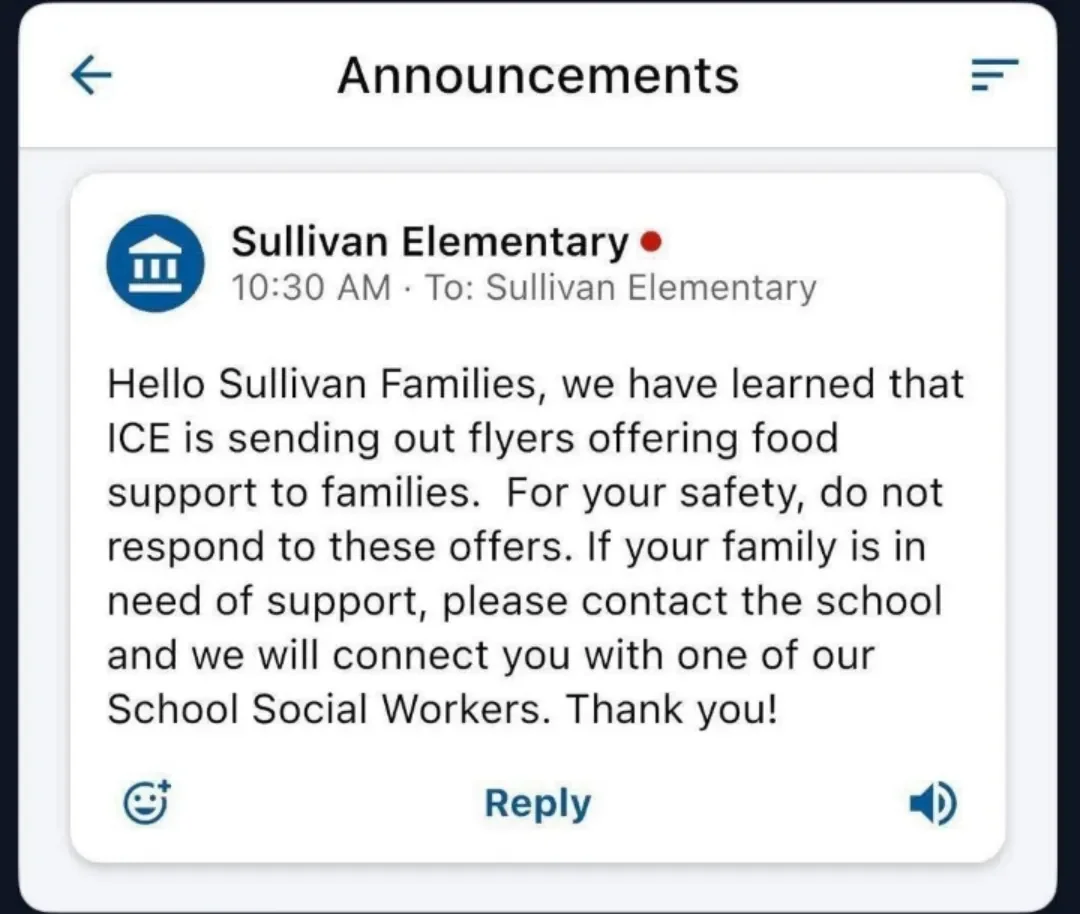
A Minnesota elementary school sent an urgent message to parents after flyers linked to U.S. Immigration and Customs Enforcement began circulating in the community offering “food support.” School officials warned families not to respond and urged them to rely on trusted school or local resources instead. The incident has intensified fear and distrust among immigrant families and raised broader questions about enforcement tactics, food insecurity, and the role of schools as safe spaces.
An elementary school in Minnesota has issued an urgent warning to families after flyers offering “food support” — reportedly linked to ICE — began appearing in surrounding neighborhoods. While the flyers appeared to advertise assistance for families facing food insecurity, school administrators advised parents not to engage with the outreach and instead seek help directly through the school or established community organizations.
The message, which circulated among parents and later appeared on social media and Reddit, reflects growing anxiety among immigrant and mixed-status families who fear that contact with immigration authorities — even under the guise of aid — could carry serious risks.
What the school told parents
According to families who received the notice, the school emphasized several key points:
-
The school does not coordinate with ICE or immigration enforcement agencies.
-
Families should avoid responding to unfamiliar flyers offering assistance if the source is unclear or connected to law enforcement.
-
Parents in need of food support should contact school staff, social workers, or trusted local nonprofits.
School officials framed the message as a precautionary step meant to protect families and maintain trust within the school community. For many parents, the warning underscored the reality that schools are often the most trusted institutions in immigrant neighborhoods.
Why ICE-linked “food support” raised alarm
For many families, the concern was not just about the flyers themselves, but about who was behind them. ICE is widely known as a federal enforcement agency responsible for immigration detention and deportation. As a result, any outreach associated with ICE — even if labeled as humanitarian — is often met with suspicion.
Parents and community advocates questioned why an enforcement agency would offer food assistance rather than leaving that role to social service agencies or nonprofits. Some feared the outreach could be used to collect personal information, identify households, or encourage contact that could later lead to enforcement actions.
Even without evidence of such intent, the perception alone was enough to cause fear. Several parents said they worried that responding to the flyers could expose their immigration status or that of relatives living in the same household.
Community reaction: fear, anger, and distrust
Reaction from the community was swift. Parents shared screenshots of the school’s message in group chats and online forums, while discussions quickly spread across Reddit, particularly in threads focused on immigration and local news.
Common themes in the reaction included:
-
Distrust of enforcement agencies engaging in social services.
-
Anger that food insecurity might be used, intentionally or not, as a point of contact with vulnerable families.
-
Fear that children and parents could be indirectly affected by enforcement activity tied to school communities.
Some commenters argued that even if the intention behind the flyers was legitimate, the approach was fundamentally flawed given ICE’s role and reputation. Others emphasized that the incident illustrates how deeply enforcement policies affect daily life, even in spaces meant to be safe for children.
Food insecurity meets immigration anxiety
The controversy also highlights a larger issue: food insecurity among families already living under economic and social pressure. Rising housing costs, inflation, and unstable employment have increased reliance on school meal programs and food banks.
For immigrant families, those challenges are compounded by fear of surveillance or enforcement. Local volunteers and nonprofit groups reported that some families are reluctant to leave their homes, visit food shelves, or attend community events when enforcement activity is perceived to be nearby.
In this context, schools often become the primary access point for assistance. Many districts provide free meals, weekend food packs, and referrals to local aid organizations — all without requiring families to disclose immigration status.
Schools as safe spaces
Educators and child advocates have long argued that schools must remain safe and trusted environments, regardless of a family’s legal status. When parents fear that outside agencies may be operating nearby, school attendance and engagement can suffer.
Advocates warn that fear can lead to:
-
Students missing school
-
Parents avoiding communication with teachers
-
Increased stress and anxiety among children
By issuing a warning, the Minnesota school signaled that it sees protecting families as part of its responsibility — not just educating students.
Broader context in Minnesota
Minnesota, particularly the Twin Cities area including Minneapolis, has a long history of refugee resettlement and immigrant communities. Local leaders have frequently emphasized that schools, hospitals, and places of worship should not be sites of immigration enforcement.
The flyer incident comes amid continued national debate over immigration policy and enforcement practices. While federal agencies operate independently of local school districts, the overlap in communities often creates tension.
Calls for clearer boundaries
Following the school’s warning, some community advocates called for clearer boundaries between immigration enforcement and social services. They argue that assistance programs should be handled by civilian agencies or nonprofits that families already trust.
Others suggested that any outreach related to basic needs should clearly state what information, if any, is collected and how it will be used. Without transparency, they say, even well-intended efforts can cause harm.
What families are being advised to do
In response to the situation, schools and community groups are advising families to:
-
Use school-based food programs and known local nonprofits
-
Avoid sharing personal information with unfamiliar outreach efforts
-
Verify the source of any flyers or messages offering assistance
-
Reach out to school administrators if unsure about safety
These steps are meant to ensure families receive support without increasing fear or risk.
Why this story matters beyond Minnesota
Although this incident occurred at a single elementary school, it resonates nationally. Across the U.S., immigrant families face similar dilemmas when enforcement agencies intersect with daily life.
The strong reaction shows how fragile trust has become — and how quickly it can be shaken. For many parents, the idea that an enforcement agency might be involved in food assistance is not reassuring; it is alarming.
Bottom line
The Minnesota school’s warning highlights a deeper issue: when families fear the institutions meant to help them, even basic needs like food become politicized and dangerous. Schools remain one of the few places where trust still exists, and administrators acted quickly to preserve that trust.
Whether ICE revises its outreach approach or not, the incident has already made one thing clear: in immigrant communities, who offers help matters just as much as the help itself.






Leave a Comment