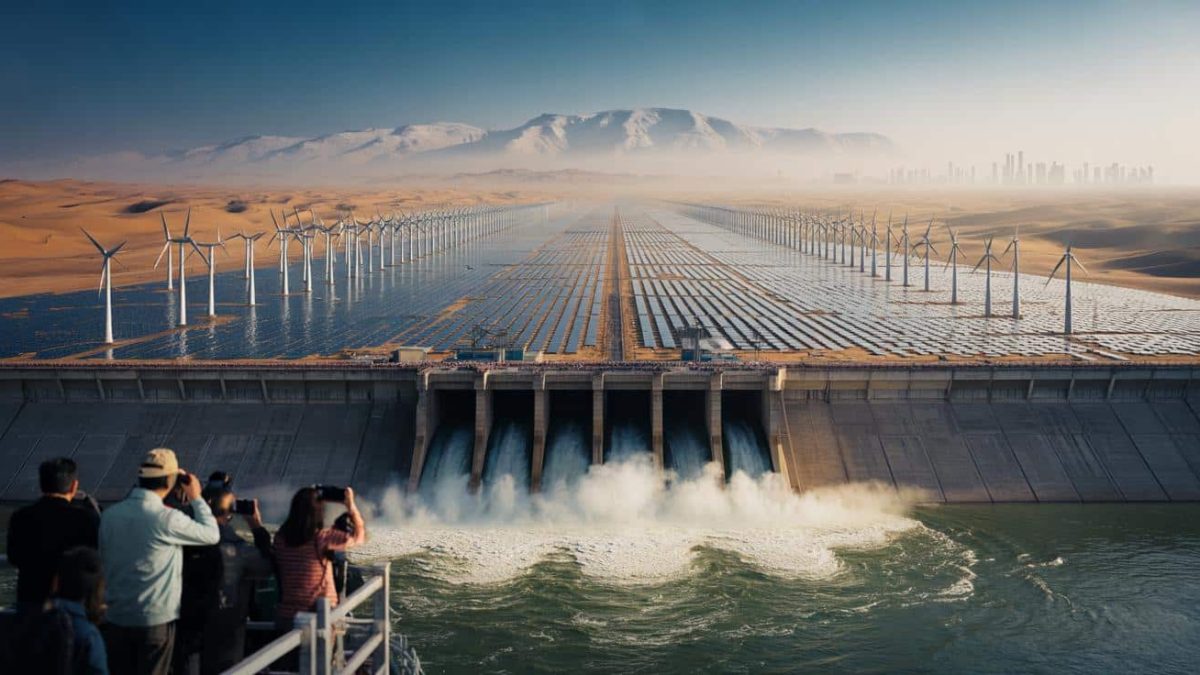
When we think of engineering marvels, China’s construction achievements consistently dominate global conversations. Yet behind the impressive statistics and breathtaking structures lies a more profound question: At what point does human ambition to control nature cross into territory that challenges the fundamental mechanics of our planet? This inquiry becomes increasingly relevant as China unveils projects that dwarf even its previously record-breaking accomplishments.
The Legacy of the Three Gorges Dam
Before exploring China’s newest ventures, we must acknowledge the elephant in the room—or rather, the dam across the Yangtze River. The Three Gorges Dam, completed in 2012, stands as one of humanity’s most impressive feats of engineering. Spanning 2,335 meters and rising 185 meters above the river surface, this structure generates approximately 98.8 terawatts of electricity annually and controls the flow of one of the world’s most significant waterways.
However, the Three Gorges Dam achieved something beyond hydroelectric power generation. Scientific studies have indicated that the massive weight of water held behind the dam—approximately 39 trillion kilograms—creates a gravitational redistribution effect. This concentration of mass in Central China measurably affects Earth’s rotation, albeit subtly. The dam’s water reservoir essentially causes the Earth to spin marginally slower, an effect detected by satellite measurements and confirmed by geophysicists worldwide.
This phenomenon might sound like science fiction, but it represents a genuine, quantifiable impact on planetary mechanics. The extra mass concentrated in one location alters how Earth’s mass is distributed, similar to how a figure skater spins slower when extending their arms outward.
Beyond Water: The Next Generation of Mega-Projects
Having successfully influenced global rotation through hydroelectric infrastructure, China has apparently decided that one planet-altering project isn’t enough. Recent announcements and ongoing construction initiatives suggest the nation is pursuing an even more ambitious agenda that would dwarf the Three Gorges Dam in scale and scope.
These newer projects encompass multiple dimensions: unprecedented hydroelectric installations in remote regions, artificial landscape modification on continental scales, and infrastructure projects that move so much earth and water that their combined mass redistribution effects could theoretically be detected by precision measurement instruments.
The scale is almost incomprehensible. We’re discussing projects that involve moving billions of tons of material, diverting major river systems, and creating artificial lakes the size of small nations. When you aggregate these efforts, you’re looking at planetary-scale engineering that rivals natural geological processes in scope.
Understanding the Physics Behind the Impact
To grasp why these projects matter beyond their immediate regional benefits, we need to understand basic physics principles. Earth’s rotation isn’t static—it’s influenced by mass distribution. This principle, known as the moment of inertia, explains why concentrated masses affect rotational speed.
When water accumulates behind a dam, especially at specific latitudes, it redistributes Earth’s mass. A dam built closer to the equator has a different effect than one built near the poles. The Three Gorges Dam, positioned at approximately 31 degrees north latitude, creates a measurable but relatively modest effect on rotation.
However, when you combine multiple massive projects—particularly if they’re strategically positioned or if they collectively involve unprecedented quantities of water and earth movement—the cumulative effect becomes more significant. Scientists estimate that sufficiently large-scale water redistribution could theoretically create detectable changes in Earth’s rotation period, potentially altering day length by milliseconds.
The Environmental and Geopolitical Dimensions
While the physics captures headlines, the practical implications deserve equally serious consideration. These mega-projects transform ecosystems, displace populations, and create long-term environmental consequences. The Three Gorges Dam submerged over 1,200 towns and villages, displacing 1.3 million people.
China’s newer initiatives promise even more extensive impacts. Massive water diversion projects that redirect rivers from their natural courses could affect weather patterns, agricultural productivity, and regional ecosystems across multiple nations. When engineering projects become large enough to influence planetary mechanics, their environmental footprint inevitably expands proportionally.
Furthermore, these projects carry geopolitical weight. Water control means resource control. Nations downstream from massive dams and water redirection projects become dependent on upstream nations’ water management decisions. This reality has already created tensions, and larger projects will likely intensify these dynamics.
Technological Innovations Driving Ambition
What makes these projects possible now, when they would have been impossible two decades ago? Advances in construction technology, materials science, and project management have removed many previous constraints.
Modern tunneling equipment can bore through mountains that would have seemed impenetrable to earlier engineers. New concrete formulations allow structures to achieve unprecedented scales while maintaining durability. Artificial intelligence and advanced modeling enable planners to predict and mitigate potential problems before construction even begins.
Drone technology, satellite surveying, and real-time monitoring systems mean that projects of unimaginable complexity can be coordinated across vast distances. What once required armies of workers can now be achieved with fewer personnel, though the scale of Chinese projects still involves hundreds of thousands of workers.
The Future of Planetary-Scale Engineering
As China continues pushing engineering boundaries, we face important questions about limits and consequences. Should there be international agreements governing projects with planetary-scale impacts? How do we balance engineering ambition against environmental stewardship? What responsibility do nations have to others when their mega-projects affect global systems?
These questions lack simple answers. China’s projects generate enormous benefits—clean electricity, flood control, economic development, and technological advancement. Simultaneously, their cumulative environmental and planetary impacts merit serious examination and international dialogue.
The reality is that humanity increasingly possesses the capability to reshape Earth’s geography, water systems, and potentially even rotational mechanics. Whether we possess the wisdom to wield these capabilities responsibly remains the crucial question of our era.










Leave a Comment