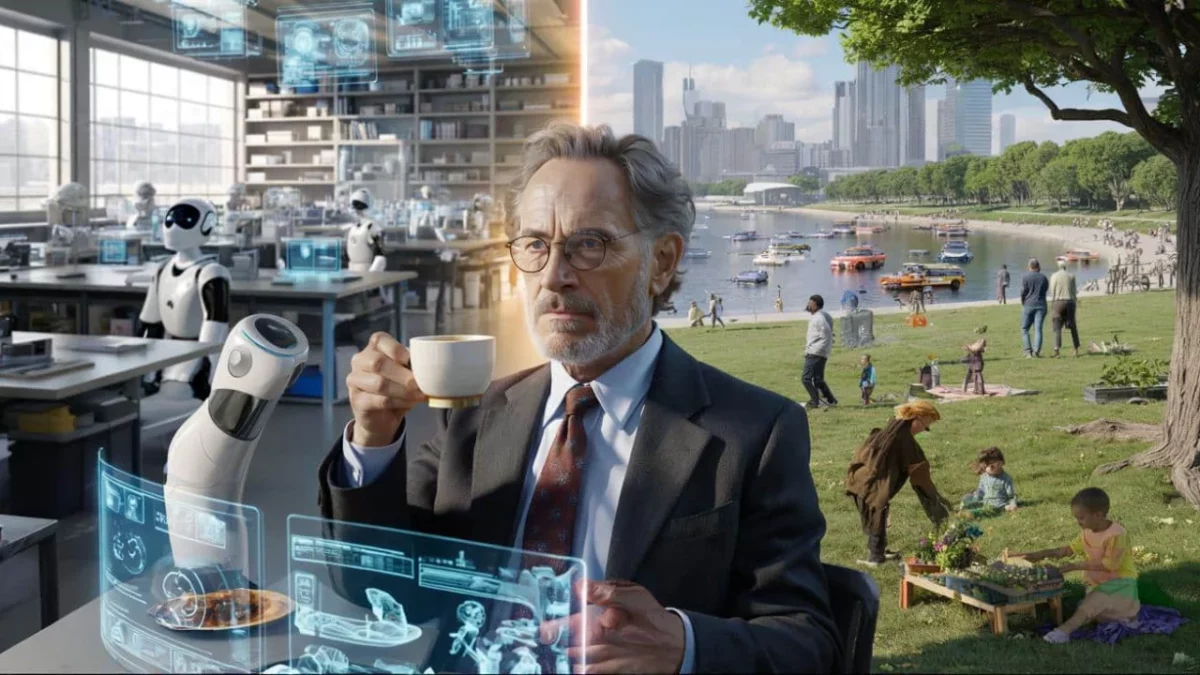
Picture a reality where your alarm clock becomes optional. The morning routine transforms from a rush to the office into a leisurely breakfast with nowhere urgent to be. This vision of unlimited free time has captivated the imagination of some of the world’s most influential minds, from quantum physicists to billionaire entrepreneurs. Yet beneath this appealing surface lies a profound question that few want to address: if machines handle most work, what replaces the jobs that once structured our lives?
The Vision of Unlimited Leisure
The concept of a work-free future isn’t new, but it’s gaining momentum from unexpected corners of the intellectual world. Renowned scientists and technology leaders have begun publicly discussing a scenario where technological advancement reaches a point of singularity—where artificial intelligence and automation become so sophisticated that human labor becomes optional rather than necessary.
The appeal is undeniable. Imagine redirecting the thousands of hours currently spent in cubicles, factories, and offices toward personal growth, creative pursuits, family time, and community engagement. No more choosing between career ambitions and personal relationships. No more sacrificing health and mental well-being for productivity metrics. The promise extends beyond mere comfort; it suggests a fundamental restructuring of human civilization around what genuinely matters to people rather than what generates revenue.
This vision builds on centuries of automation. The industrial revolution freed farmers from fields. Manufacturing robots eliminated repetitive factory tasks. Digital technology displaced countless administrative positions. Each wave of technological disruption was supposed to create leisure time, yet somehow we’re collectively working harder than ever. The question becomes: will the next wave be different?
The Technology That’s Making It Possible
Recent breakthroughs in artificial intelligence, machine learning, and robotics suggest we’re entering genuinely uncharted territory. Machines can now diagnose diseases with accuracy matching experienced physicians. They can write code, create artwork, analyze financial data, and engage in complex decision-making. Unlike previous automation waves that typically affected single industries or specific tasks, contemporary AI development is moving horizontally across virtually every sector simultaneously.
The sophistication comes from algorithms that learn, adapt, and improve autonomously. They don’t require explicit programming for every scenario. They can handle nuance, context, and even creativity in ways that earlier automation technologies never could. A robot arm on a factory floor was limited to its programmed sequence. Modern AI can learn from millions of examples and generate novel solutions to problems.
This difference matters enormously. When automation was slow and targeted, economies had time to transition workforces, develop new industries, and retrain displaced workers. The current pace of AI advancement compresses this transition period, potentially creating societal disruption faster than we can adapt.
The Employment Crisis Nobody’s Discussing Openly
Here’s where the narrative often splits into two contradictory stories, and neither addresses the genuine problem. One perspective optimistically claims that technology always creates new jobs. The other dismisses concerns about mass unemployment as Luddite thinking. Both avoid uncomfortable truths.
When agricultural machinery displaced farm workers, industrial jobs appeared. When manufacturing automation reduced factory positions, the service industry expanded. But each transition involved decades of hardship, displaced communities, and generational struggles. More critically, each previous wave of automation required human beings to perform new work that machines couldn’t handle. The emerging challenge is that artificial intelligence isn’t specialized in one area—it’s becoming general purpose.
If machines can do legal research, accounting, programming, teaching, medical diagnosis, and graphic design, what new industries absorb millions of displaced professionals? The historical pattern breaks down when machines approach or exceed human capability across most cognitive domains.
Beyond Work: Redefining Human Purpose
The physicists and tech visionaries discussing this future aren’t entirely naive. Many acknowledge that the transition represents humanity’s most significant challenge since agriculture was invented. The difference is they frame it as an opportunity rather than a catastrophe.
Their argument contains genuine wisdom: humans have repeatedly defined themselves through work out of necessity, not because work is inherently valuable. For centuries, most people labored for survival. Work structured identity, provided purpose, and organized daily routines. But these functions developed because alternatives weren’t available, not because they’re optimal expressions of human potential.
Imagine a society where basic needs were guaranteed—housing, nutrition, healthcare, education—through automation’s productivity. People could pursue work that genuinely interested them rather than work that paid bills. An engineer might become a sculptor. An accountant might become a teacher. A doctor might become a musician. Labor would shift from compulsory employment to voluntary contribution.
The Missing Conversation About Distribution

What’s notably absent from most discussions about this technological utopia is the question of who owns and benefits from automation. If machines produce wealth but only enrich those who own the machines, we don’t get a leisure society—we get a feudal system with better technology.
The future where most people have abundant free time while living securely requires solving a distribution problem that markets alone have never solved. It demands either unprecedented taxation of machine productivity, universal basic income funded by automation dividends, or a fundamental restructuring of property rights. These are political and philosophical problems, not technological ones.
Yet technological pioneers often treat them as solved issues or inevitable outcomes of progress. They’re not. Distribution models are chosen, not determined by physics or computer science.
Toward a Realistic Future
The truth likely exists between extremes. We won’t achieve technological utopia automatically, but we also won’t see unchanged employment structures persist indefinitely. The transition will be messy, involving both genuine hardship and unexpected opportunities.
What we need isn’t blind optimism that markets will handle everything, nor pessimism that collapse is inevitable. We need intentional design of social systems that ensure automation’s productivity benefits everyone, not just capital owners. We need educational systems that prepare people for a world where employment might be optional. We need political movements brave enough to make explicit choices about how to distribute abundance.
The physicists and entrepreneurs might be right about the future’s technological possibilities. But possibility isn’t destiny. Between vision and reality lies a gap we fill with choices, policies, and values. That gap is where the actual challenge lies.







Leave a Comment