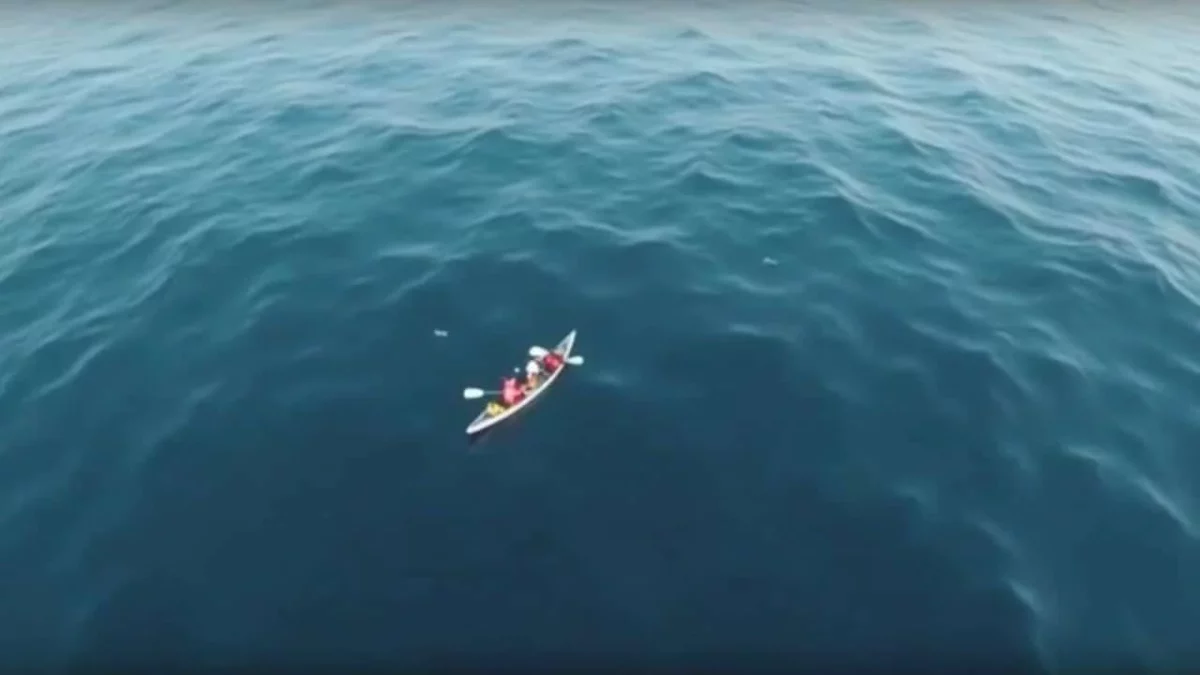
The Pacific Ocean stretches endlessly, a realm of mystery and solitude that attracts adventurers seeking to test their limits. For some, the appeal lies in the challenge of human endurance. For others, it’s the promise of witnessing nature’s grandeur in its rawest form. Few experiences, however, combine both elements quite like the one experienced by independent ocean rower James Mitchell during his solo expedition last spring.
The Unexpected Encounter Begins
Mitchell’s journey along the California coast seemed routine on that particular afternoon. Armed with navigational equipment, water supplies, and years of rowing experience, he had ventured beyond the typical shipping lanes seeking tranquility and the meditative rhythm of his strokes against the water. What he found instead was something far more extraordinary—and initially, deeply unsettling.
The first sign came as a subtle disturbance in the water’s surface. Rather than the usual gentle swells, Mitchell noticed rhythmic undulations that seemed purposeful and deliberate. Within moments, a massive shape emerged approximately forty meters from his vessel. Then another. And another. What had begun as a solitary encounter quickly evolved into a gathering that would test both his composure and his understanding of marine wildlife behavior.
Mitchell found himself surrounded by approximately thirty-seven humpback whales, each individual weighing up to forty-five metric tons. His fourteen-foot rowing shell suddenly felt impossibly small. The initial instinct to panic gave way to cautious observation as he realized the whales exhibited no aggressive behavior toward his presence.
Understanding the Gathering: Migration or Feeding Event?
Marine biologists reviewing footage and accounts of Mitchell’s encounter have offered several competing theories about why such a large congregation had assembled in that particular location. The timing of the encounter—early spring—coincides with the northbound migration season for humpback whales, yet the specific aggregation pattern suggested something more complex than simple passage through the area.
Dr. Patricia Gonzalez, a cetacean behavior specialist at the Pacific Marine Research Institute, suggests that the congregation may have been engaged in a coordinated feeding event. “Humpback whales are known to employ sophisticated hunting strategies involving bubble nets,” Gonzalez explains. “When they locate concentrated prey fields, multiple individuals often converge on the same location, creating opportunities for cooperative feeding behaviors.”
This explanation gains credibility when examining the krill and small fish populations in the region during that period. Oceanographic data indicated an unusually rich nutrient zone had developed due to upwelling currents, potentially attracting the large whale congregation. The whales’ presence in Mitchell’s location may have represented a calculated response to abundant food resources rather than a coincidental gathering.
Alternatively, researchers have considered whether the assembly represented a social gathering. Humpback whales demonstrate complex social structures and have been observed engaging in what appears to be recreational behavior, including breaching and tail-slapping. Some individuals within the pod may have been young whales learning migratory routes or feeding techniques from experienced adults, making such gatherings valuable for knowledge transmission within whale populations.
The Human Element: Safety Concerns and Nautical Protocol
Mitchell’s encounter raises legitimate questions about maritime safety when humans operate small vessels in whale-populated waters. While whales rarely target human-occupied boats, collisions do occur, particularly when visibility is limited or when whales are engaged in feeding activities and may be less aware of surface conditions.
Navigation authorities have implemented several protocols designed to minimize human-whale interactions. The International Maritime Organization recommends maintaining minimum distances from large cetaceans, typically 100 yards or more when possible. For recreational rowers and small-vessel operators, such distances require heightened vigilance and quick decision-making capacity.
“The remarkable aspect of Mitchell’s situation was his complete calmness,” notes Captain Richard Hayes, a maritime safety consultant specializing in whale-populated waters. “Many people panic when encountering large whales, potentially making dangerous maneuvers. Mitchell remained stationary, reduced his profile, and allowed the whales to move around him. This passive approach likely contributed to the safe resolution of what could have been a dangerous situation.”
Rare Proximity: What It Means for Scientific Understanding
The incident provided researchers with unusually detailed observations of whale behavior in the presence of stationary human observers. Mitchell documented his encounter through photographs, video recordings, and detailed written observations, creating a valuable dataset for marine scientists. The documentation revealed subtle interactions between individual whales, including what appeared to be coordinated movement patterns and communication through specific vocalizations.
Such close observation opportunities are remarkably rare in marine biology. Most whale research depends on distance observations from larger vessels or aerial surveys. Mitchell’s perspective, literally at water level amid the whale congregation, offered insights that traditional research methodologies cannot easily replicate.
The recordings captured what appeared to be a matriarchal individual leading the congregation, younger whales maintaining specific distances from larger adults, and coordinated surfacing patterns consistent with cooperative feeding strategies. These behavioral elements contribute to broader scientific understanding of cetacean social hierarchy and communication.
The Broader Implications: Human-Wildlife Coexistence
As ocean recreation becomes increasingly popular and whale populations gradually recover from historical hunting pressures, human-whale encounters will likely become more frequent. Mitchell’s experience serves as a case study in peaceful coexistence between humans and marine megafauna.
Environmental organizations have seized upon this incident as an educational opportunity. Rather than portraying whales as dangers to be avoided, they emphasize the possibility of sharing ocean spaces respectfully. Educational programs now reference Mitchell’s encounter when teaching marine wildlife awareness and responsible ocean stewardship.
The incident also highlights the importance of preserving marine habitats that support whale populations. The convergence of whales in Mitchell’s location directly correlated with healthy prey populations and suitable oceanographic conditions. Maintaining such environmental quality requires ongoing conservation efforts and sustainable fisheries management.
Reflections on an Extraordinary Moment
For Mitchell personally, the encounter represented far more than an exciting anecdote. In interviews following the event, he described experiencing a profound shift in his relationship with the ocean. What had been a personal challenge—conquering distance through solo rowing—transformed into something more contemplative and spiritually significant.
“Being in the presence of something so magnificent, so powerful, yet so peaceful, changes your perspective,” Mitchell reflected. “I realized that the ocean isn’t a space I’m conquering. It’s a space I’m visiting, temporarily sharing with countless creatures infinitely more adapted to it than I am.”
This sentiment resonates with broader discussions about human humility in nature. As climate change and environmental pressures increasingly impact marine ecosystems, experiences like Mitchell’s remind us of our connection to and dependence upon healthy ocean environments.
His encounter ultimately transcends the specific incident. It represents a moment of genuine connection between human and wild nature, documented and shared in an age where such unmediated experiences grow increasingly rare. Whether viewed through the lens of marine biology, adventure narrative, or philosophical reflection, the rower’s day among the whales reminds us that the ocean still holds mysteries capable of transforming those who venture into it with respect and open minds.











Leave a Comment