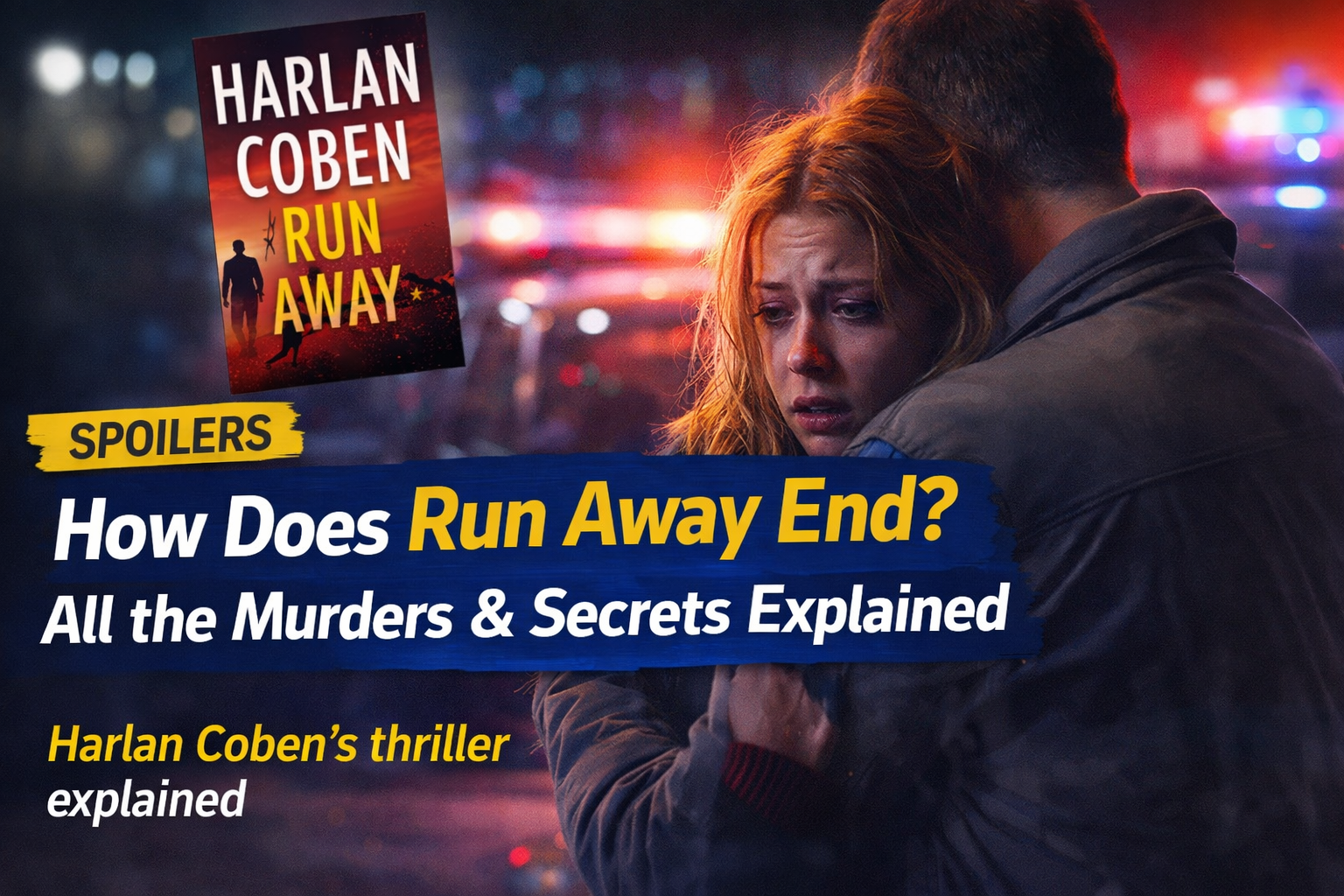
Harlan Coben’s gripping thriller Run Away delivers a devastating finale packed with murder revelations, hidden identities, and emotional twists that reframe the entire story. As readers race through the final chapters, one question dominates: what really happened—and who was responsible?
Here’s a clear, step-by-step breakdown of the ending, explaining every major murder, secret, and twist, in a way that’s easy to follow and Discover-safe.
What Is Run Away About? (Quick Recap)
Run Away follows Simon Greene, a father searching for his estranged daughter Paige after she vanishes into a dangerous world of drugs, crime, and exploitation. What begins as a missing-person story quickly escalates into a violent conspiracy involving corrupt officials, traffickers, and long-buried secrets.
As Simon gets closer to the truth, the body count rises—and nothing is as it first appears.
🔎 Key Characters at the Center of the Mystery
| Character | Role in the Story |
|---|---|
| Simon Greene | Father searching for his runaway daughter |
| Paige Greene | Missing daughter hiding a dark secret |
| Aaron | Paige’s boyfriend with a violent past |
| Elena | Woman linked to organized crime |
| Helena | Powerful criminal figure pulling strings |
| Gil Perez | Corrupt law enforcement officer |
Who Is Really Killing People in Run Away?
One of the novel’s biggest misdirections is who the real killer is.
At first, suspicion falls on:
-
Drug dealers
-
Organized crime figures
-
Paige’s dangerous associates
But the truth is far more personal—and shocking.
🔴 The Big Reveal:
Paige Greene herself is responsible for multiple killings.
She is not a helpless victim. She is actively eliminating people who threaten to expose or exploit her, acting out of fear, survival instinct, and trauma.
Why Did Paige Kill Them?
Paige’s murders are not random.
Each killing connects to:
-
Attempts to control or traffic her
-
Threats to reveal her identity
-
Efforts to use her as leverage
Paige learned early that running wasn’t enough—she had to erase the danger entirely.
Her actions blur the line between victim and perpetrator, forcing readers to confront uncomfortable moral questions.
The Shocking Truth About Paige’s Past
The novel’s darkest secret emerges near the end:
🧨 Paige was sexually assaulted years earlier—and her family never knew.
This trauma explains:
-
Her sudden disappearance
-
Her emotional withdrawal
-
Her willingness to use violence
Paige believes that staying close to her family puts them at risk. Running away, in her mind, was an act of protection—not rebellion.
Aaron’s Death: What Really Happened?
Aaron’s murder is one of the most misunderstood moments in the book.
-
Initially, it appears to be drug-related violence
-
Evidence suggests organized crime involvement
✔ The Truth:
Paige killed Aaron after realizing he was planning to hand her over to criminal contacts.
It’s a turning point that confirms Paige is no longer running—she’s fighting back.
The Role of Corruption and Cover-Ups
As Simon digs deeper, he uncovers a network of corruption involving:
-
Law enforcement
-
Criminal middlemen
-
Influential figures protecting traffickers
Gil Perez, a corrupt cop, plays a key role in manipulating investigations and shielding powerful players. His actions allow crimes to continue unchecked—until the truth finally surfaces.
How Does Run Away Actually End?
The ending is deliberately quiet and unsettling, rather than explosive.
Final Outcome Explained:
-
Paige survives
-
The conspiracy is exposed
-
Several criminals are dead or disgraced
-
Simon learns the full truth—but at a cost
Paige does not face traditional justice. Instead, the story closes with ambiguity, forcing readers to decide whether survival excuses her actions.
Simon must accept a painful reality:
Finding your child doesn’t always mean saving them.
Why the Ending Is So Divisive
Readers often split into two camps:
😟 Critics Say:
-
Paige escaped accountability
-
The ending feels morally unresolved
👍 Supporters Argue:
-
Paige is a survivor, not a villain
-
The ending reflects real-world trauma
This moral tension is intentional—and one of the novel’s greatest strengths.
Is Run Away Connected to Other Harlan Coben Stories?
Yes. Like many Coben novels, Run Away exists in a loosely connected universe:
-
Recurring themes of family secrets
-
Corrupt institutions
-
Trauma resurfacing years later
However, the story stands alone and requires no prior reading.
Why Run Away Remains Popular
Even years after release, Run Away continues trending because:
-
Its ending invites debate
-
It tackles uncomfortable truths about trauma
-
It subverts the “rescued child” trope
With renewed interest in Coben adaptations, many readers are revisiting the novel—or discovering it for the first time.
Final Verdict
Run Away doesn’t offer easy answers. Instead, it delivers a haunting conclusion where love, guilt, and survival collide. The murders are real. The secrets are devastating. And the ending lingers long after the final page.
If you’re looking for a thriller that challenges your sense of right and wrong, Run Away earns its reputation.









Leave a Comment