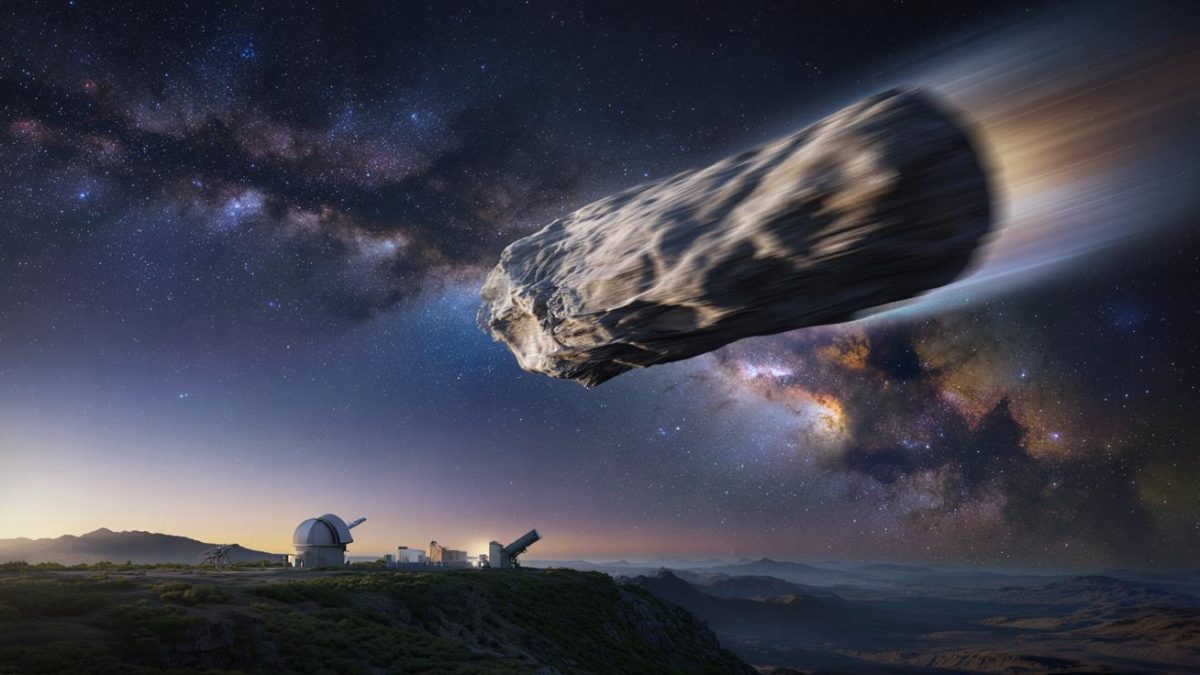
The universe continues to surprise us with its mysteries, and a recent astronomical discovery has left scientists breathless. An object of extraterrestrial origin, having journeyed through the vast emptiness of space for millions of years, has finally entered our detection range, moving at speeds that defy conventional understanding of celestial mechanics. This discovery opens new chapters in our comprehension of interstellar travel and the composition of distant solar systems.
A Visitor From Beyond
When astronomers first detected this peculiar object, initial measurements seemed almost impossible. The sheer velocity at which this cosmic wanderer approached our solar system suggested something fundamentally different about its origin. Rather than following trajectories typical of objects born from our sun’s gravitational influence, this entity exhibited characteristics pointing to an entirely different solar system, potentially light-years away.
The discovery process itself represents a triumph of modern astronomical technology. Advanced telescopes equipped with sophisticated spectral analysis tools allowed researchers to determine not just the object’s speed, but also its chemical composition, temperature, and potential age. Every measurement pointed toward the same startling conclusion: this was genuine extraterrestrial material, not merely another comet or asteroid born from our own cosmic neighborhood.
What makes this discovery particularly fascinating is the rarity of such encounters. For decades, scientists theorized about the possibility of interstellar objects passing through our solar system, but actually detecting one proved exponentially more challenging than predicted. The sheer distances involved and the relatively small size of most objects made successful detection seem like finding a specific needle in an impossibly vast haystack.
Understanding the Numbers
The velocity measurements reveal an object traveling at speeds exceeding expectations by considerable margins. Standard calculations for objects within our solar system rarely produce velocities of this magnitude, yet this visitor moves through space with apparent ease and consistency. Researchers have calculated that this object possesses sufficient speed to escape the gravitational pull of our sun, explaining its trajectory that brings it close to Earth before inevitably continuing its journey toward the distant reaches of our galaxy.
Engineers and astrophysicists have spent countless hours analyzing the physics behind such velocities. The energy required to maintain such speeds across interstellar distances speaks to phenomena we’re only beginning to understand. Did this object originate from a supernova event that accelerated it beyond normal speeds? Was it ejected from a planetary system through gravitational interactions with massive celestial bodies? These questions drive further investigation and theoretical modeling.
The trajectory data provides crucial information about where this object originated and how long it has traveled through the void. By extrapolating backward along its current path and considering gravitational influences along the way, scientists can narrow down potential source regions. Some preliminary analyses suggest origin points within the nearby stellar neighborhood, though confirming exact origins remains scientifically challenging.
Composition and Chemistry Clues
Perhaps as intriguing as the object’s speed is what it’s made of. Spectroscopic analysis reveals an unusual combination of elements and compounds not commonly found in our solar system’s objects. Heavy metals, exotic ice compositions, and organic compounds indicate formation in an environment vastly different from our sun’s planetary nursery. These chemical signatures act as fingerprints, potentially identifying the object’s true home system.
The presence of certain isotopes in unusual proportions particularly captured scientists’ attention. These isotopic ratios don’t match anything previously cataloged in our cosmic backyard, suggesting formation around a different star with different nucleosynthesis patterns. This discovery fundamentally expands our understanding of planetary system diversity and the incredible range of conditions under which celestial bodies form.
Researchers continue examining high-resolution imagery to identify surface features and structural characteristics. Preliminary observations indicate significant cratering and pitting patterns, suggesting a long journey through space exposed to countless microscopic impacts. These surface features tell stories of millennia spent traversing the cosmic wilderness, accumulating scars from encounters with space dust and radiation.
What This Means for Science
This discovery validates theoretical models that have predicted interstellar object passages for years. Scientists can now study actual physical evidence rather than relying solely on mathematical projections and computer simulations. Every measurement taken adds confidence to existing models while simultaneously raising new questions about cosmic phenomena.
The implications extend far beyond astronomy. Detecting and analyzing such objects improves our ability to scan the heavens for other visitors and potentially hazardous objects. As humanity continues expanding its presence beyond Earth, understanding the frequency and characteristics of interstellar objects becomes increasingly important for space travel safety and mission planning.
Looking Forward
As this cosmic messenger continues its inevitable departure from our solar system, observations continue around the clock. Space agencies worldwide have redirected instruments and resources toward capturing every possible measurement. The window of opportunity won’t remain open indefinitely—within months, the object will recede beyond effective detection range, disappearing once again into the cosmic expanse.
This discovery reminds us that our universe remains largely unexplored and full of surprises. The cosmos continuously presents challenges and mysteries that push the boundaries of human knowledge and technological capability. As we detect and analyze these interstellar visitors, we gain valuable insights into planetary formation processes, stellar evolution, and the dynamic nature of our galaxy.
The detection of this high-speed interstellar object represents more than a mere scientific curiosity—it marks a milestone in humanity’s ongoing quest to understand our place in the universe. Each discovery builds upon previous knowledge, gradually illuminating the vast cosmic landscape surrounding our little blue planet. Who knows what other visitors are currently traveling through the darkness, waiting to be detected by our ever-improving instruments?











Leave a Comment