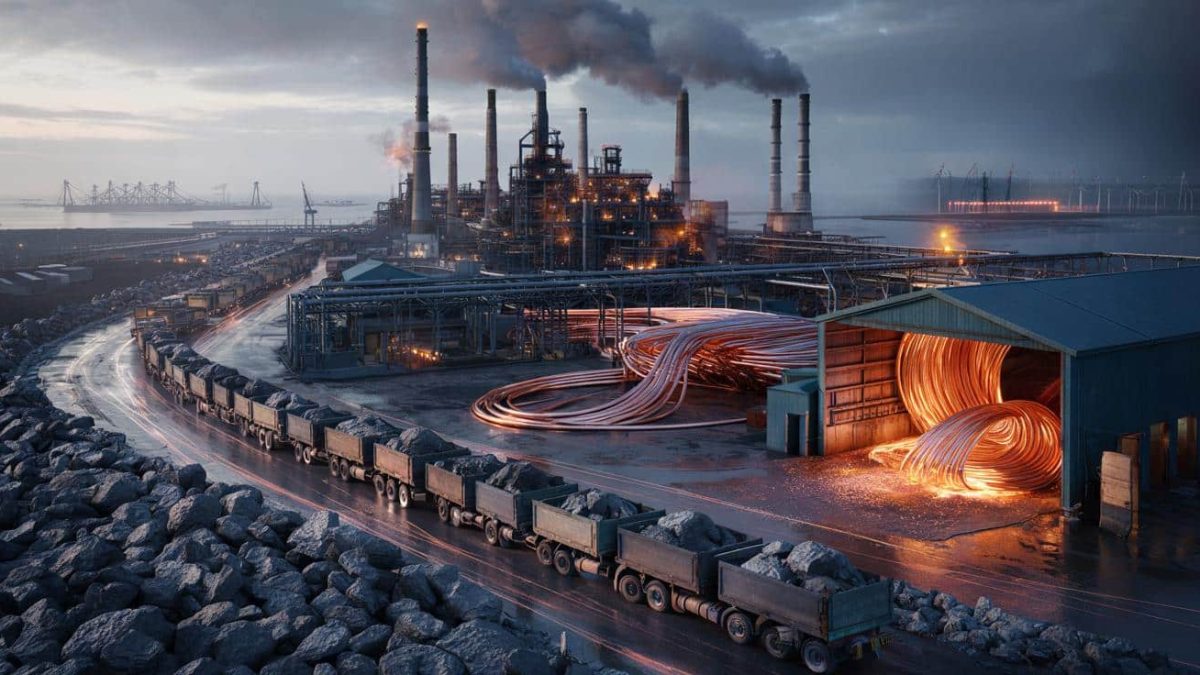
The conversation around China’s industrial dominance typically circles back to one topic: rare earth elements. Policymakers, analysts, and business leaders have spent years strategizing how to reduce dependence on Beijing’s near-monopoly over these crucial materials. Yet while global attention remained fixated on rare earths, another equally transformative shift occurred with minimal fanfare. China has methodically established itself as the world’s undisputed leader in copper refining, a position that carries consequences far beyond mining economics.
The Copper Refining Reality Check
Copper is not glamorous. Unlike rare earths, which power electric vehicles and renewable energy systems, copper lacks the technological mystique that captures headlines. It is, however, absolutely fundamental to modern civilization. Every electrical grid, telecommunications network, and renewable energy installation depends on refined copper. The global economy quite literally runs on copper wiring.
Today, China processes roughly 40% of the world’s copper supply. This figure represents something far more significant than market share—it reflects structural dependency. Major copper producers in Chile, Peru, and Indonesia ship raw ore to Chinese refineries because the infrastructure, expertise, and economies of scale exist nowhere else at comparable efficiency. Even Western nations with domestic refining capacity increasingly find themselves reliant on Chinese-processed copper for cost-competitive supply.
How China Built Its Refining Empire
Beijing’s copper refining dominance did not emerge by accident. It resulted from deliberate policy and strategic investment spanning three decades. In the 1990s, China recognized that controlling raw materials was only half the equation. The real power lay in processing and value addition. Government support channeled capital toward building world-class refining infrastructure while Western nations outsourced these operations to reduce domestic environmental regulations and labor costs.
This strategic divergence proved decisive. Chinese refineries became increasingly sophisticated, employing advanced pyrometallurgical and hydrometallurgical techniques that maximize recovery rates and minimize waste. Meanwhile, the number of primary copper refineries in developed nations declined steadily. The United States, once a copper refining powerhouse, now operates a fraction of its historical refining capacity.
Investment in refining technology accelerated during the 2000s commodity boom. Chinese firms secured long-term contracts with major mining operations globally, guaranteeing steady feedstock supplies. Simultaneously, Beijing ensured refineries had access to competitive energy, favorable financing, and minimal regulatory friction. When commodity prices collapsed in 2015, competitors struggled while Chinese operations sustained production through government-backed support mechanisms.
The Supply Chain Vulnerability
China’s copper refining dominance creates a critical vulnerability in global supply chains that few have adequately addressed. Unlike rare earths, which have several potential substitutes or recycling options, refined copper has limited alternatives for most applications. A disruption in Chinese refining capacity would rapidly cascade through industries worldwide.
Consider the renewable energy sector, which depends heavily on refined copper for solar installations, wind turbines, and battery systems. A supply interruption would instantly slow the global energy transition, affecting climate commitments and investment returns. Similarly, telecommunications infrastructure, semiconductor manufacturing, and construction industries would all face immediate challenges.
The geopolitical implications should concern strategists. Just as Beijing leveraged rare earth exports for diplomatic advantage in past disputes with Japan and other nations, refined copper could become a tool for exerting economic pressure. The scenario is not hypothetical—it is a logical extension of existing industrial patterns.
Why Western Nations Missed This Shift
Several factors explain why China’s copper refining ascendancy attracted minimal policy attention compared to rare earths. First, copper lacks the technological cachet of rare earths. Policymakers and media outlets naturally gravitate toward materials associated with cutting-edge technology rather than commodities with established industrial applications.
Second, the shift occurred gradually rather than through sudden market disruption. Unlike rare earth shortages that triggered immediate alarm, copper refining capacity migrated incrementally as market economics favored consolidation in China. By the time the dependency became apparent, altering course required massive capital investment and political will.
Third, Western companies initially benefited from cost savings achieved through outsourcing refining operations. Corporate profit margins improved when expensive domestic refineries were shuttered and processing moved to lower-cost jurisdictions. These benefits did not encourage questioning underlying supply chain vulnerabilities.
The Path Forward: Rebuilding or Accepting Dependency?
Governments now face difficult choices regarding copper refining strategy. Rebuilding substantial domestic refining capacity requires years of planning, significant capital investment, and acceptance of higher processing costs. Environmental and regulatory standards that prevented previous refining operations remain in place, raising questions about where new facilities could operate.
Some nations explore recycling infrastructure as an alternative to primary refining. Copper recycling has inherent advantages—it requires less energy than primary refining and reduces environmental impact. However, current recycling capabilities cannot meet global demand, particularly given accelerating copper consumption from electrification and renewable energy deployment.

Strategic reserves represent another approach, though storing refined copper indefinitely presents logistical and financial challenges. Some policymakers advocate for diversifying refining locations beyond China, potentially supporting existing refineries in other countries and developing new capacity in allied nations. This strategy distributes risk but does not eliminate Chinese dominance.
What This Means for Global Trade and Competition
China’s copper refining dominance signals a broader pattern in global industrial organization. While developed nations focused on high-value technology sectors, China systematically consolidated control over essential processing infrastructure across multiple commodities. This strategy positions Beijing to shape global supply chains and influence industrial policy worldwide.
For businesses and governments alike, the copper refining situation demands reassessment of supply chain strategies. Over-reliance on single processing locations, regardless of geopolitical considerations, creates unnecessary vulnerability. Companies need to evaluate how dependencies on Chinese refining affect their resilience and strategic flexibility.
Conclusion: A Critical Blind Spot
China’s quiet dominance in copper refining represents one of the most significant yet overlooked aspects of global economic power. While policymakers continue debating rare earth strategies, the infrastructure for processing copper has already consolidated under Beijing’s control. Recognizing this reality does not require panic, but it demands serious strategic attention. Whether through diversified refining capacity, accelerated recycling efforts, or revised trade policies, the world needs to address the copper refining vulnerability now, before geopolitical circumstances force a response under pressure. The commodity may lack glamor, but its importance to modern society makes Chinese dominance in copper refining far more consequential than most realize.











Leave a Comment