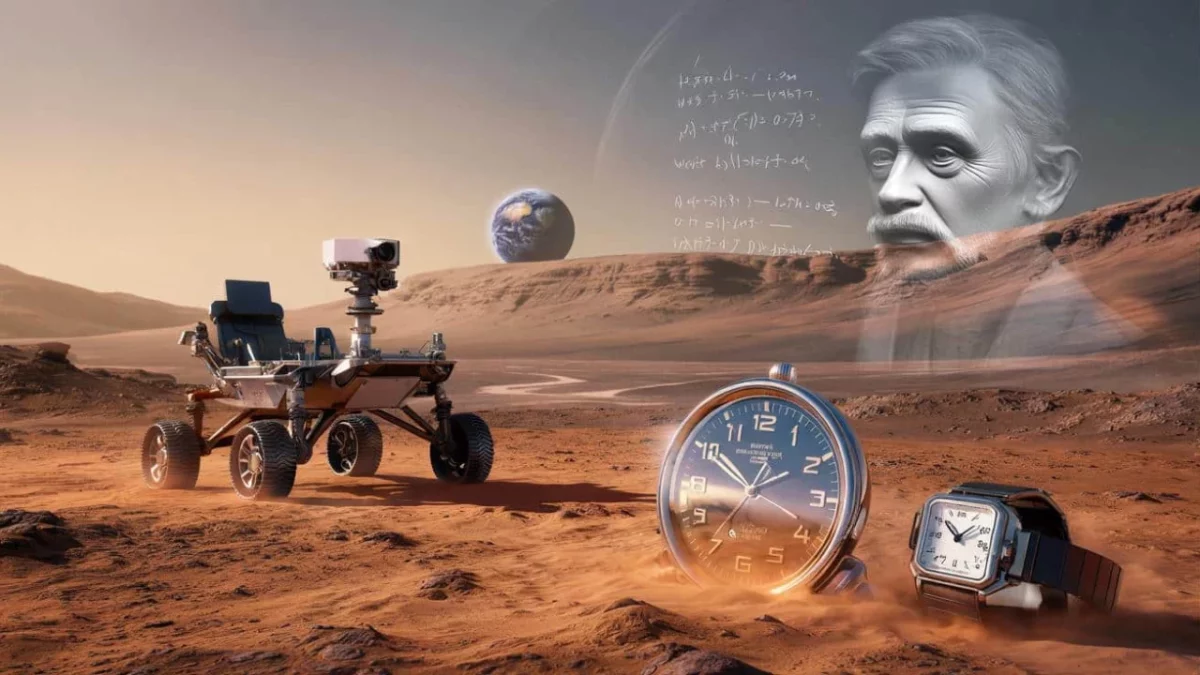
When Albert Einstein published his theory of general relativity over a century ago, he suggested something radical: time itself isn’t constant across the universe. Instead, gravity warps spacetime, causing clocks to tick at different rates depending on their position in a gravitational field. What seemed like abstract theoretical physics has now become a practical problem for space exploration, as Mars has empirically confirmed what Einstein predicted—and this revelation is forcing space agencies worldwide to completely overhaul their operational procedures.
The Relativity That Changed Everything
Einstein’s groundbreaking work fundamentally challenged our understanding of time and gravity. According to his theory of general relativity, massive objects like planets create gravitational wells that actually slow down time. The stronger the gravitational field, the slower time moves. On Earth, we barely notice this effect because the differences are minuscule. However, when you’re dealing with interplanetary distances and trying to coordinate the movements of sophisticated rovers and spacecraft across millions of miles, even microseconds matter.
For decades, physicists accepted this theory mathematically, but the real-world implications for space exploration seemed distant and theoretical. Engineers building Mars rovers and orbiting spacecraft had to account for relativistic effects in their calculations, but many treated them as minor corrections rather than fundamental operational constraints. That casual attitude is changing rapidly.
From Theory to Mars Reality
Recent observations from multiple Mars rovers and orbiting spacecraft have provided undeniable evidence that time actually does flow differently on Mars compared to Earth. The effect is subtle but measurable: clocks on Mars tick approximately 0.3 parts per billion slower than identical clocks on Earth. While this sounds infinitesimally small, it accumulates over time and creates significant challenges for any sophisticated equipment operating on or around the Red Planet.
This wasn’t unexpected to physicists, but confirming it through actual Martian observations transformed it from theoretical prediction into operational reality. The data came from extremely precise atomic clocks aboard Mars orbiters and the accumulated timing discrepancies in rover navigation systems. Scientists compared these measurements against Earth-based atomic clocks and found systematic differences that perfectly matched Einstein’s predictions about gravitational time dilation.
Why This Matters for Space Missions
The implications for future Mars exploration are profound. When a rover needs to execute a critical maneuver or a crewed spacecraft approaches the Martian surface, timing becomes absolutely critical. Guidance systems rely on synchronized clocks to calculate positions and velocities. Communication signals travel at the speed of light, which is incredibly fast, but even light takes between 3 and 22 minutes to travel between Earth and Mars depending on orbital positions.
If mission control on Earth is working with a clock that ticks at a different rate than the clock on a spacecraft or rover, navigation errors compound. A one-millisecond timing error might seem negligible, but it can translate into a position error of hundreds of meters after extended operations. For a precision landing on Mars or a rendezvous between multiple spacecraft, such errors could be catastrophic.
Atomic clocks are already extremely expensive and delicate instruments, but accounting for time dilation means future deep space missions must either carry more sophisticated timekeeping systems or adjust their operational protocols to account for relativistic effects. The Mars rovers currently operating on the surface rely heavily on Earth-based time corrections and sophisticated software that constantly adjusts for this disparity.
Practical Solutions for Future Missions
Space agencies have begun implementing solutions to address this relativistic challenge. One approach involves more frequent synchronization between spacecraft clocks and Earth-based atomic time standards. Mission controllers now regularly transmit timing corrections to rovers and orbiting spacecraft to keep everything synchronized despite the effects of gravity.
Another strategy involves developing more robust navigation systems that are less dependent on synchronized atomic clocks. Engineers are exploring quantum entanglement-based communication and other advanced technologies that might eventually allow for more reliable positioning and timing across interplanetary distances, independent of gravitational effects.
For crewed missions to Mars, this becomes even more critical. Astronauts will need navigation systems that account for time dilation not just between Earth and Mars, but potentially within localized Martian operations as well. A spacecraft in Martian orbit experiences slightly different gravitational effects than equipment on the surface, meaning even at the same location, multiple timing systems might show different times.
The Broader Implications
Beyond the immediate engineering challenges, this confirmed observation represents a triumph of scientific methodology. Einstein made a prediction about the fundamental nature of spacetime over a hundred years ago, and modern technology has finally allowed us to verify it across the solar system. This gives physicists tremendous confidence in other predictions from relativity theory and opens doors to testing even more exotic predictions about quantum gravity and the nature of spacetime itself.
The discovery also highlights how theoretical physics eventually becomes practical engineering. Scientists and engineers working on Mars missions must now take Einstein seriously in their everyday work, not just acknowledge him in physics textbooks. This convergence of abstract theory and concrete operational challenges drives innovation and pushes both fields forward.
Looking Toward Future Exploration
As humanity plans more ambitious Mars missions, including permanent bases and crewed expeditions, understanding and compensating for time dilation becomes increasingly important. The same relativistic effects that confirmed Einstein’s theory will affect power systems, communication networks, and life support systems that depend on precise timing.
Space agencies are already incorporating relativistic corrections into their planning for the next generation of Mars rovers and the upcoming crewed missions. What once seemed like a minor theoretical footnote has become essential engineering knowledge. Future spacecraft builders and mission controllers will routinely account for Einstein’s predictions the same way engineers today account for friction or air resistance.
The Red Planet has thus become not just a destination for exploration, but a laboratory for testing fundamental physics. As we continue sending more sophisticated equipment to Mars and eventually human explorers, Einstein’s insights will guide us forward, reminding us that the universe operates on principles far more strange and wonderful than our everyday experience suggests.









Leave a Comment