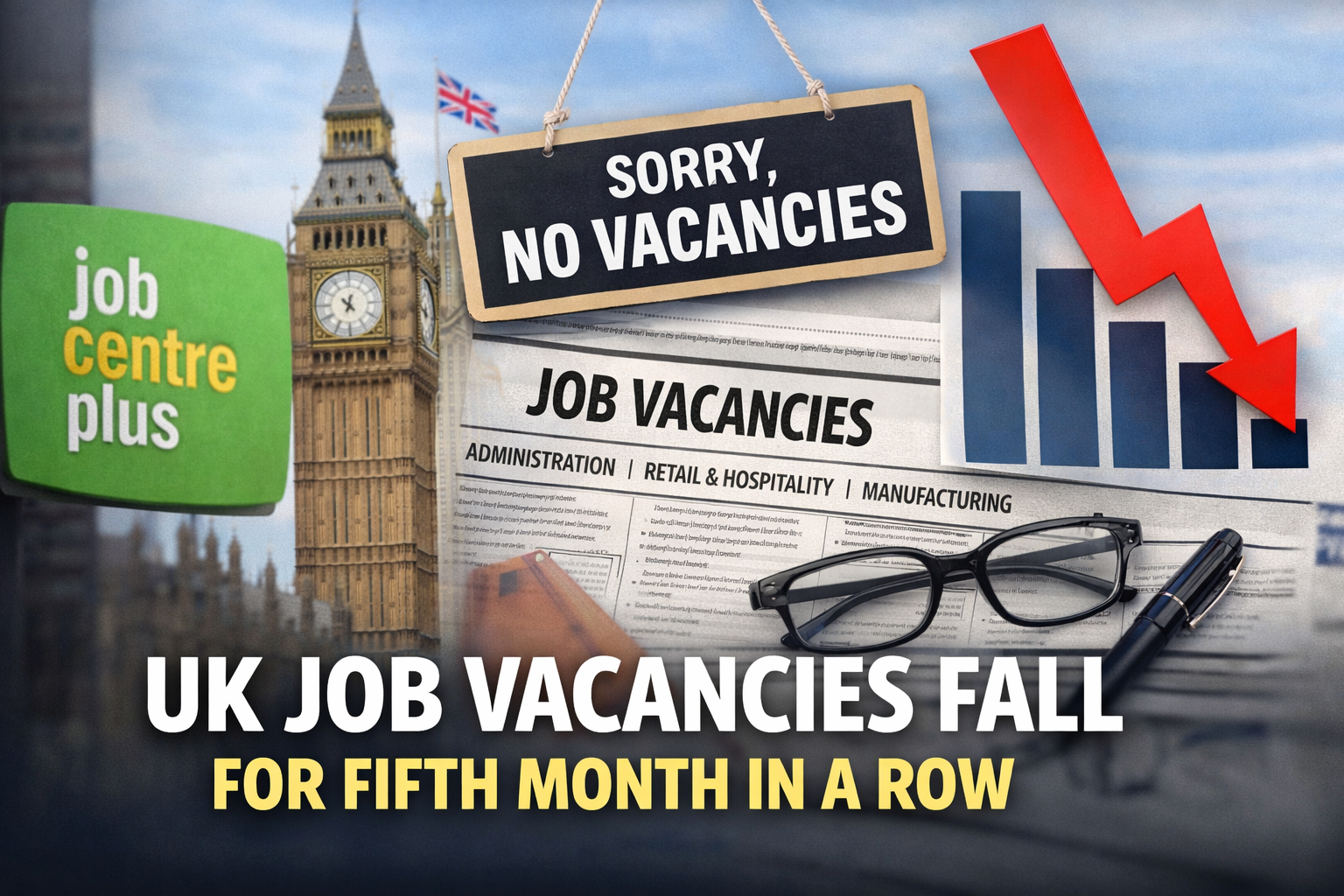
UK job vacancies have fallen for the fifth consecutive month, confirming that the labour market is losing momentum after several years of unusually high demand for workers. The latest figures suggest that while Britain is not facing an employment crisis, finding a new job is becoming steadily harder for many people.
The data shows employers across multiple sectors are slowing recruitment, delaying expansion plans and becoming more selective about who they hire. For jobseekers, that means fewer openings, longer searches and more competition for each role.
This trend arrives at a delicate time for the government led by Keir Starmer, which has promised to deliver economic stability, encourage business investment and improve living standards after years of disruption.
What the Latest Data Shows
According to the most recent labour market release from the Office for National Statistics, the total number of job vacancies in the UK has continued to decline, extending a downturn that began earlier in the year.
While unemployment remains low by historical standards, vacancies are often seen as an early warning signal. When employers stop advertising roles, it usually reflects weaker confidence about future growth.
UK Job Vacancies Trend
| Period | Job Vacancies Trend | Key Signal |
|---|---|---|
| Post-pandemic peak | Very high | Labour shortages, rapid hiring |
| Early slowdown | Gradual decline | Employers becoming cautious |
| Last five months | Continuous fall | Hiring restraint spreading |
| Current position | Below recent highs | Cooling, not collapsing market |
Economists say the figures point to cooling demand rather than mass layoffs, but the persistence of the decline is raising concern.
Why Are Employers Pulling Back?
Several overlapping pressures are influencing hiring decisions across the UK economy.
Slower Economic Growth
Economic growth has been weak and uneven, with long periods of near-stagnation. Businesses are less willing to expand teams when sales growth is uncertain.
For many employers, maintaining existing staff now takes priority over recruiting new ones.
High Operating Costs
Although inflation has eased, companies continue to face:
-
Elevated energy and utility bills
-
Higher wage costs
-
Increased tax and regulatory pressures
Small and medium-sized businesses, which employ a large share of the workforce, are particularly exposed.
Borrowing Costs and Investment Hesitation
Interest rates remain higher than the ultra-low levels of the past decade. This has made borrowing more expensive and reduced appetite for long-term investment, including hiring.
Which Sectors Are Seeing the Biggest Drop in Vacancies?
The slowdown is not uniform. Some industries are being hit far harder than others.
Job Vacancies by Sector
| Sector | Vacancy Trend | Explanation |
|---|---|---|
| Retail & Hospitality | Sharp decline | Weak consumer spending, high costs |
| Construction | Falling steadily | Slower housing and infrastructure demand |
| Manufacturing | Declining | Global demand and trade pressures |
| Office & Admin | Softening | Hiring freezes, role consolidation |
| Healthcare | More resilient | Long-term staff shortages |
| Education | Slowing growth | Budget pressures despite demand |
Retailers and hospitality firms have cut back on seasonal hiring, while construction companies report fewer new projects entering the pipeline.
What This Means for Jobseekers
For people actively looking for work, the shift in the labour market is already noticeable.
Tougher Competition
With fewer vacancies available, each advertised role now attracts more applicants. Employers can afford to be more selective, extending recruitment timelines and raising entry requirements.
Reduced Bargaining Power
During the labour shortage years, workers could negotiate higher pay or flexible conditions. That balance is now shifting back towards employers, especially in lower-paid sectors.
Skills Matter More Than Ever
Candidates with transferable skills, digital literacy and flexibility across roles are better placed to succeed. Many jobseekers are now turning to retraining or upskilling to improve their chances.
Keir Starmer Considers Social Media Ban for Under-16s as UK Looks to Australia’s Model
What Happens to Wages Next?
So far, wage growth has remained relatively strong, largely because inflation forced employers to raise pay to retain staff. However, economists warn this may not last.
If vacancies continue to fall, pay growth is likely to slow, which could place additional strain on households already facing high rents, food costs and energy bills.
Wage Outlook Snapshot
| Factor | Impact on Wages |
|---|---|
| Falling vacancies | Downward pressure |
| Inflation easing | Less justification for big rises |
| Employer caution | Fewer bonuses and promotions |
| Skills shortages | Pay holds up in specialist roles |
Regional Differences Across the UK
The hiring slowdown is uneven across regions, raising concerns about widening inequalities.
-
London and the South East remain stronger but are seeing declines in tech and professional roles
-
Industrial regions are affected by manufacturing slowdowns
-
Coastal and rural areas reliant on tourism face weaker seasonal demand
Without targeted investment, these regional gaps may grow.
Political and Policy Implications
The figures add pressure on the government to demonstrate that its economic strategy can deliver real improvements.
During the election campaign, Labour emphasised stability, long-term planning and growth driven by investment. A prolonged slowdown in hiring risks undermining confidence if living standards fail to improve.
Business groups are calling for:
-
Clearer tax policy
-
Support for small firms
-
Skills and training investment
-
Confidence-boosting economic signals
Are Job Losses Coming Next?
A fall in vacancies does not automatically lead to rising unemployment. Many companies are choosing to pause hiring rather than cut staff.
However, vacancies are often a leading indicator. If the trend continues for too long, people leaving jobs may struggle to find replacements, pushing unemployment higher over time.
For now, economists describe the situation as a cooling labour market rather than a crisis.
What Employers Are Saying
Employers describe a cautious environment rather than panic.
Many firms are:
-
Freezing non-essential recruitment
-
Using short-term contracts instead of permanent hires
-
Increasing workloads for existing staff
Automation and productivity improvements are also being used to avoid expanding headcount.
The Human Reality Behind the Numbers
Behind the statistics are graduates struggling to secure their first role, mid-career workers hesitant to change jobs, and families worried about income stability.
Five months of falling vacancies may seem technical, but for many households it translates into anxiety and delayed life decisions — from moving home to starting a family.
What to Watch Next
The direction of the jobs market over the coming months will depend on:
-
Interest rate cuts and credit conditions
-
Government economic policy clarity
-
Consumer spending recovery
-
Global economic stability
A modest recovery in growth could stabilise hiring. Without it, the slowdown may deepen.
Conclusion
The UK labour market is no longer overheated — it is cooling, and the effects are becoming clearer with each monthly release.
While unemployment remains low, the five-month fall in job vacancies signals a shift that workers, employers and policymakers cannot ignore. Whether this becomes a temporary pause or a longer-term problem will depend on economic decisions made now.
For millions of people, the message is simple: the jobs market is tightening, and the margin for error is shrinking.









Leave a Comment