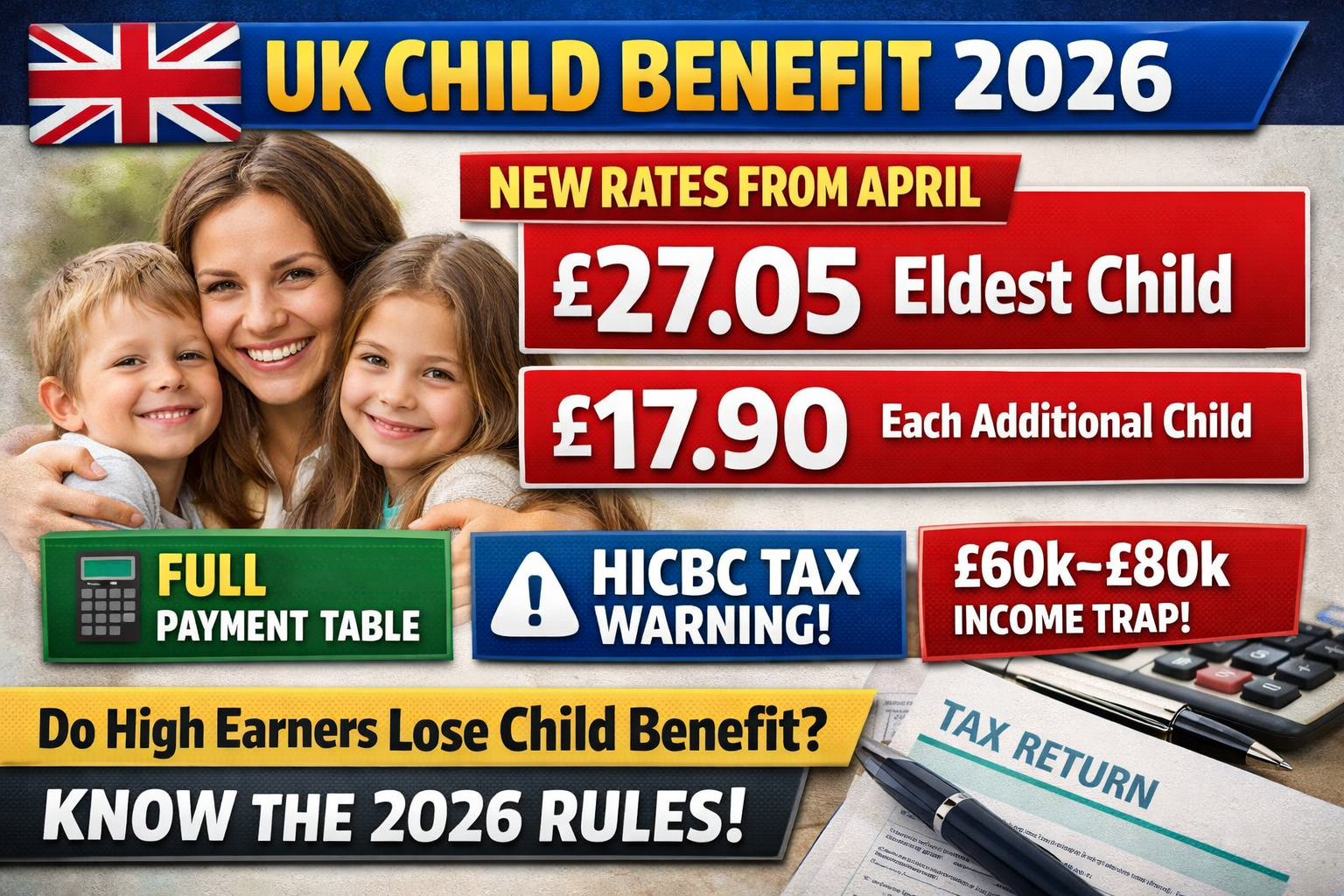
If you’re claiming (or thinking of claiming) Child Benefit in the UK, the biggest “2026” update is the uprated weekly rates starting 6 April 2026 (the 2026/27 tax year). The government confirmed an increase in line with CPI (September 2025) of 3.8%, taking the weekly payment to £27.05 for the eldest/only child and £17.90 for each additional child. Hansard+2GOV.UK+2
Below is a full, practical guide (with tables) so you can estimate your 2026 payout, avoid common mistakes, and understand how the High Income Child Benefit Charge (HICBC) works in 2026.
What is Child Benefit (and why it still matters in 2026)
Child Benefit is a regular payment for people responsible for a child. It’s not means-tested in the usual way, which is why many families claim it even when they expect to repay some or all of it through tax.
Even when the cash payment is reduced or repaid due to HICBC, claiming can still be valuable because it can:
-
protect National Insurance credits for a parent/carer who isn’t working or earns below the NI threshold
-
help ensure a child gets a National Insurance number automatically around age 16 (a common reason higher earners still register even if they opt out of payments)
(Those two points are commonly highlighted in UK Child Benefit guidance and commentary; the latest “process” news has been around simplifying how HICBC is paid.) MoneyWeek+1
Child Benefit rates: what changes in 2026
The key update is the 2026 to 2027 provisional weekly rate (applies from 6 April 2026).
Table 1: Weekly Child Benefit rates (UK)
| Tax year (6 Apr to 5 Apr) | Eldest/only child (per week) | Each additional child (per week) |
|---|---|---|
| 2026–2027 (provisional) | £27.05 | £17.90 |
| 2025–2026 | £26.05 | £17.25 |
| 2024–2025 | £25.60 | £16.95 |
Source: UK government published rates & allowances tables. GOV.UK+1
The same uplift was also stated in Parliament, including Guardian’s Allowance (useful if you care for a child whose parents have died). Hansard
How much you could get in 2026: yearly estimates
Child Benefit is usually paid every 4 weeks (though you can request weekly in some circumstances). The easiest way to understand it is to translate weekly rates into annual totals.
Table 2: Approx annual Child Benefit amounts for 2026/27 (based on weekly rates)
| Children in your household | Calculation | Approx annual total |
|---|---|---|
| 1 child | £27.05 × 52 | £1,406.60 |
| 2 children | (£27.05 + £17.90) × 52 | £2,337.80 |
| 3 children | (£27.05 + £17.90×2) × 52 | £3,268.00 |
| 4 children | (£27.05 + £17.90×3) × 52 | £4,198.20 |
Rates used: 2026/27 provisional weekly amounts. GOV.UK+1
Real-life note: If your claim starts or ends mid-year (or the child turns 16/changes education status), your annual total will be pro-rated.
The other big “2026” topic: High Income Child Benefit Charge (HICBC)
If you or your partner receive Child Benefit and the higher earner has “adjusted net income” above the threshold, the higher earner may have to repay some (or all) of the benefit via the tax system.
The thresholds that apply into 2026
-
For tax years starting 2024–2025 and onward, the threshold is £60,000. GOV.UK+1
-
Child Benefit is fully withdrawn (100% charge) once income reaches £80,000 under the current taper design. TaxScape+2House of Commons Library+2
Table 3: HICBC taper (current design applying since 6 April 2024)
| Higher earner’s adjusted net income | What happens |
|---|---|
| £60,000 or less | No HICBC (you keep the full Child Benefit) |
| £60,001 to £80,000 | Partial repayment via HICBC (taper applies) |
| £80,000+ | Benefit effectively fully repaid via HICBC |
Government overview + Parliament briefing confirm the threshold and full-withdrawal point. GOV.UK+2House of Commons Library+2
How the repayment is calculated
Since the 2024 reform, the charge works at 1% of the Child Benefit for every £200 of income above £60,000 (instead of 1% per £100 under the older rules). UK Tax Policy Map+2Personal Finance Society+2
That means if the higher earner’s income is:
-
£65,000 → £5,000 over the threshold → 5,000/200 = 25 → 25% of Child Benefit repaid
-
£70,000 → £10,000 over → 10,000/200 = 50 → 50% repaid
-
£80,000 → £20,000 over → 20,000/200 = 100 → 100% repaid UK Tax Policy Map+1
Important: It’s based on the higher earner’s individual income, not combined household income. GOV.UK+1
A practical 2026 example (so you don’t get surprised)
Let’s say you have 2 children in 2026/27:
-
Annual Child Benefit (approx): £2,337.80 (Table 2)
If the higher earner’s adjusted net income is £68,000:
-
Income over £60,000 = £8,000
-
£8,000 / £200 = 40
-
HICBC = 40% of Child Benefit
-
Repayment ≈ 0.40 × £2,337.80 = £935.12
-
Net kept ≈ £1,402.68
(Your exact figures depend on the precise weeks paid and your adjusted net income calculation.)
“Latest” admin change that can affect families going into 2026: easier repayment via PAYE
A very practical recent development is HMRC expanding/rolling out a system so some people liable for HICBC can opt to have the charge collected through PAYE, rather than needing to handle it only via a Self Assessment return. That’s been presented as a way to reduce admin and missed filings/penalties. MoneyWeek
Why this matters: Many Child Benefit issues aren’t about eligibility—they’re about paperwork, deadlines, and people not realising they needed to do Self Assessment because of HICBC.
How to claim Child Benefit (and the 2026 checklist)
Who can claim
Typically, the person who is responsible for the child claims (only one person can receive it for a child at a time).
What you’ll need
Commonly required:
-
your National Insurance number
-
the child’s birth/adoption details
-
bank details
The 2026 checklist that avoids common regrets
-
Claim even if you’ll repay via HICBC, if you want the NI credits / NI number advantages (you can still claim and choose not to receive payments in some cases). MoneyWeek+1
-
If income is near £60,000, learn what counts as adjusted net income and whether pension contributions or Gift Aid could reduce it (this is where many families “accidentally” tip into HICBC).
-
If HICBC applies, decide whether you’ll:
-
handle it through Self Assessment, or
-
use/opt for PAYE collection where available. MoneyWeek
-
Child Benefit in the wider 2026 benefits landscape (quick context)
Child Benefit is UK-wide, but families sometimes confuse it with devolved payments. For example, Scotland has additional child-related support (like the Scottish Child Payment) that has its own rules and work-incentive debates in recent reporting. That’s separate from UK Child Benefit. The Times
FAQ (2026)
Are Child Benefit rates definitely increasing in 2026?
The published UK government rates table lists 2026–2027 (provisional) rates, and the uprating from 6 April 2026 was stated in a Parliamentary debate. GOV.UK+1
What are the Child Benefit weekly rates from April 2026?
£27.05 for the eldest/only child and £17.90 for each additional child. GOV.UK+1
Does everyone lose Child Benefit if one parent earns over £60,000?
Not automatically. You can still receive it, but the higher earner may owe HICBC (a tax charge). HICBC starts above £60,000 and fully claws back by £80,000 under the current system. GOV.UK+2House of Commons Library+2
How is HICBC calculated now?
Since the reforms starting 6 April 2024, the charge is 1% of Child Benefit for each £200 of income above £60,000. UK Tax Policy Map+2Personal Finance Society+2
What’s the newest admin update for HICBC heading into 2026?
Recent reporting highlights HMRC enabling/expanding an option to have HICBC collected via PAYE for some taxpayers, reducing reliance on Self Assessment only.






Leave a Comment