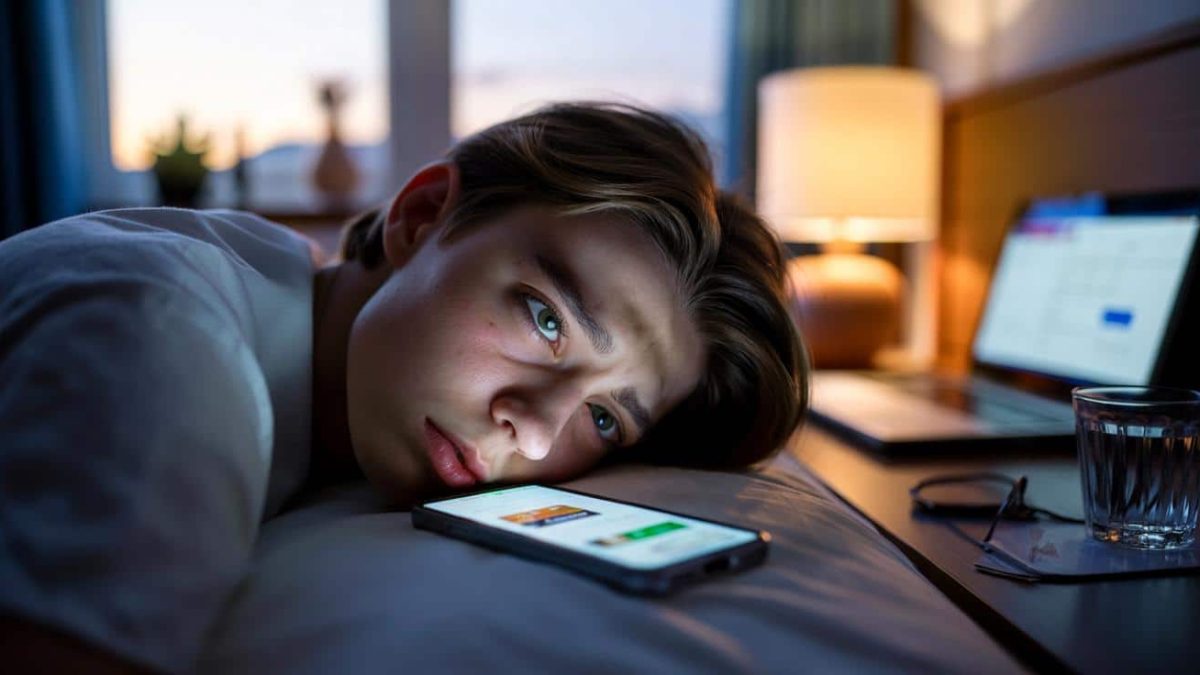
Before your feet touch the bedroom floor, your eyes have already begun their daily assault. That instinctive reach for your smartphone—the one that happens before coffee, before brushing your teeth, sometimes even before opening your eyes fully—initiates a cascade of ocular stress that compounds throughout the day. What feels like an innocent morning ritual has become one of the most consequential threats to our collective vision health.
The Silent Epidemic Nobody’s Talking About
Statistics reveal a troubling trend that most people remain blissfully unaware of. Optometrists report a 35% increase in digital eye strain complaints over the past five years alone. Yet the majority of individuals engaging in this behavior every single morning don’t even realize they’re participating in a vision-damaging cycle. The problem isn’t that screens are inherently evil—it’s that our interaction patterns with them have fundamentally changed.
We’re not using screens the way manufacturers intended. We’re holding them closer to our faces, maintaining this proximity for longer stretches, and doing so immediately upon waking when our eyes are least prepared to handle optical stress. Our ancestors never had to worry about this particular threat because it simply didn’t exist. Our eyes evolved for scanning vast landscapes and focusing on distant objects, not staring intensely at illuminated rectangles held mere inches away.
Understanding the Mechanism of Damage
The harm occurs through multiple simultaneous pathways. First, there’s the blue light component. Your smartphone screen emits significant quantities of blue light wavelengths, which penetrate deeper into the eye than other visible light colors. Upon waking, your pupils are naturally dilated, allowing more light to flood your ocular system. This combination—enlarged pupils meeting intense blue light—creates an immediate phototoxic environment within your eyes.
Second, there’s the accommodation problem. Your eye’s focusing mechanism, called the ciliary muscle, works overtime when viewing screens at close range. Unlike reading physical books, where you can vary distance and angle, smartphone screens encourage static positioning. This sustained accommodation demand causes the ciliary muscle to remain in a constant state of contraction, leading to eye fatigue that persists throughout your day.
Third, and perhaps most insidious, is the blink rate reduction. Research demonstrates that people blink approximately 66% less frequently when using smartphones compared to other activities. Blinking isn’t merely a reflex—it’s the eye’s mechanism for distributing protective tear films across the surface. Reduced blinking means inadequate lubrication, leading to dry eye syndrome that compounds over time.
Why Morning Matters More Than You Think
The timing of this habit makes the damage exponentially worse. Your eyes undergo significant changes during sleep. Tear production decreases, and your corneas become slightly dehydrated. Upon waking, your visual system needs time to recalibrate and restore its protective mechanisms. Instead of allowing this natural recovery process, we immediately introduce an optical stressor of the highest magnitude.
Morning exposure establishes a pattern that your brain learns to repeat. The neurochemical pathway between waking and phone checking becomes hardwired through repetition. Each morning reinforcement makes the habit stronger and your eyes more vulnerable. By the time noon arrives, you’ve already accumulated several hours of damage that conditions your eyes to be more susceptible to further strain throughout the afternoon and evening.
The Cumulative Effect Over Years
Individual morning sessions might seem inconsequential. A few minutes here, perhaps ten minutes there. But mathematics reveals the troubling reality. If you spend just fifteen minutes with your phone during morning hours, and you repeat this behavior 365 days per year, you’ve accumulated nearly 92 hours of morning screen exposure annually. Over a decade, that’s 920 hours of concentrated eye stress specifically timed when your visual system is most vulnerable.
Multiply this by afternoon sessions, evening usage, and professional screen time, and the total exposure becomes staggering. Studies suggest the average person now spends over eight hours daily looking at screens. Your eyes simply didn’t evolve to handle this volume of close-range, high-intensity light exposure.
Recognizing the Warning Signs
The damage doesn’t announce itself loudly. Instead, it whispers through subtle symptoms people often attribute to other causes. You might notice your vision becoming slightly blurry by mid-afternoon. Perhaps headaches appear with increasing frequency. Some people experience that gritty, sandy sensation in their eyes, especially toward evening. Others develop sensitivity to bright light that didn’t bother them previously.
These warning signs represent your eyes sending distress signals. Ignoring them doesn’t make the underlying damage disappear—it merely allows it to progress further. What begins as temporary strain can develop into chronic dry eye disease, accelerated presbyopia, or other vision complications that worsen with age.
Practical Strategies for Immediate Change
Breaking this habit requires replacing it with something equally automatic but significantly less damaging. Rather than reaching for your phone upon waking, establish a competing routine. Stretch, hydrate, or step outside into natural light. These alternatives actually benefit your eyes rather than harming them.
If you must use your phone in the morning, implement the 20-20-20 rule: every twenty minutes, look at something twenty feet away for twenty seconds. This forces your ciliary muscle to relax and allows tear distribution to occur naturally.
Consider blue light filtering glasses designed specifically for morning usage. These aren’t fashion accessories—they’re protective equipment for your most valuable sensory organs. Position your phone farther from your face, ideally at arm’s length rather than six inches away. Increase your blink rate consciously until it becomes automatic again.
The Path Forward
Your eyesight represents one of your most precious assets, yet most people protect their smartphone more carefully than their vision. This fundamental misalignment of priorities explains why eye damage accumulates silently and invisibly until irreversible harm has occurred.
The solution doesn’t require abandoning technology—it requires becoming intentional about your interaction patterns. Tomorrow morning, pause before reaching for that glowing screen. Give your eyes the gift of time to wake naturally, to recalibrate, and to prepare for the day ahead. Your future self, still blessed with clear vision decades from now, will thank you for this small but significant act of foresight.










Leave a Comment