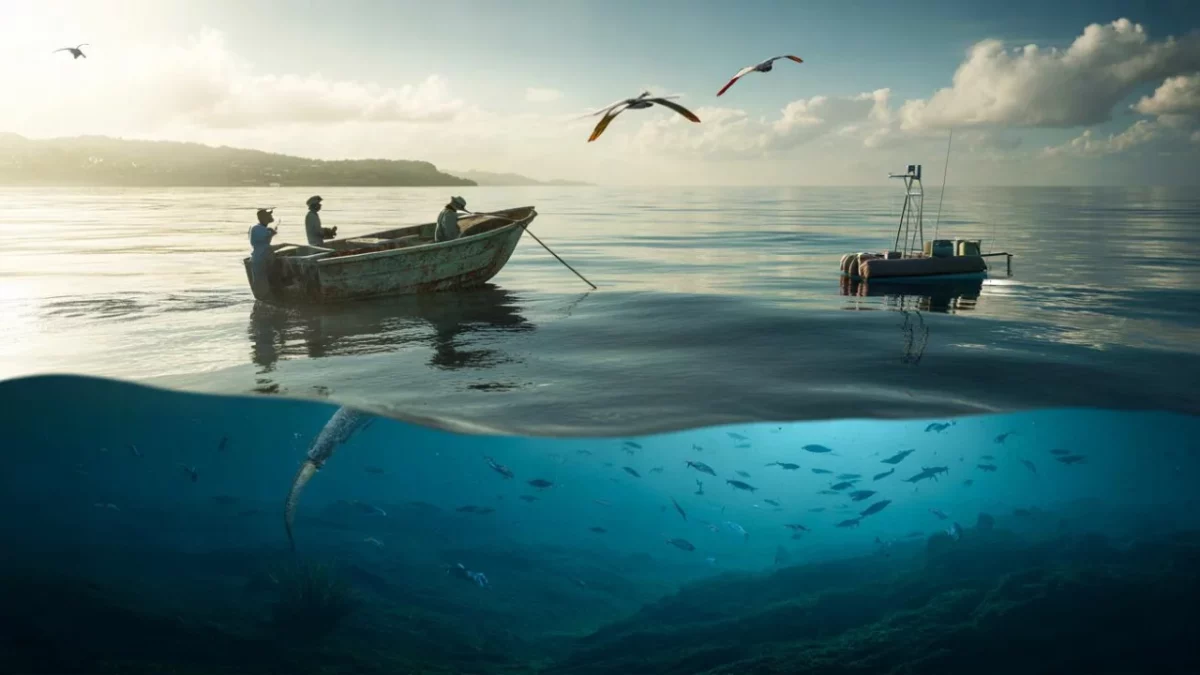
The Caribbean Sea holds many secrets, but one of its most dependable patterns has suddenly vanished. For over four decades, oceanographers have witnessed a remarkable natural phenomenon occur with clockwork precision in Panama’s coastal waters. Deep ocean currents, rich with nutrients essential for marine life, would surge toward the surface in a process known as upwelling. But in recent months, this vital cycle has broken—marking the first interruption in living memory for scientists who have built their understanding of regional ecosystems around this predictable event.
Understanding the Upwelling Phenomenon
Before exploring what went wrong, it’s essential to understand why this natural process mattered so much. Upwelling occurs when deep ocean waters, typically cold and nutrient-dense, are forced toward the surface. In Panama’s waters, this process brought phosphorus, nitrogen, and other vital minerals from the ocean depths, creating perfect conditions for phytoplankton blooms. These microscopic organisms form the foundation of the marine food web, supporting everything from small fish to whales.
The timing and reliability of Panama’s upwelling made it invaluable to researchers. They could predict when nutrients would arrive, observe how ecosystems responded, and gather consistent data year after year. This predictability transformed the region into a natural laboratory where scientists studied ocean dynamics, climate patterns, and biological productivity with remarkable precision.
When Nature’s Clock Stopped
Scientists first noticed something unusual when monitoring equipment detected lower-than-expected nutrient concentrations during the typical upwelling season. Initial suspicions focused on measurement errors or equipment malfunctions. After thorough investigations, oceanographers confirmed the troubling reality: the deep waters simply weren’t rising as they had for decades.
The implications rippled through the scientific community immediately. Research projects depended on this upwelling to function. Long-term studies tracking marine biodiversity suddenly lacked the expected biological signals. Fisheries that had benefited from the nutrient surge faced uncertain conditions. Questions multiplied faster than answers could arrive.
The Investigation Begins
Oceanographers mobilized quickly to investigate this unprecedented disruption. They examined temperature gradients, salinity levels, wind patterns, and pressure systems. Several theories emerged about what might have caused the upwelling failure.
One prominent hypothesis centered on changing wind patterns in the region. Upwelling typically occurs when strong winds push surface water away from the coast, creating a void that deep water fills from below. Satellite data from the past several months showed unusual wind behavior in the Caribbean, with certain traditional wind directions weakening significantly during critical periods. This reduced wind stress could have prevented the normal forcing mechanism that drives the upwelling process.
Another theory pointed toward broader ocean circulation changes. The Atlantic Meridional Overturning Circulation (AMOC), which encompasses the Gulf Stream and other major currents, has been showing signs of weakening in recent years. If this global-scale circulation system altered, it might have disrupted the local pressure gradients and water mass dynamics that sustained Panama’s upwelling for decades.
Climate Change’s Possible Role
Scientists examining the phenomenon couldn’t ignore the elephant in the room: climate change. Global ocean temperatures have been rising, which affects density differences between water layers. It also influences wind patterns, precipitation, and coastal dynamics. Some researchers suggested that the failure of Panama’s upwelling might represent a direct impact of climate disruption on a local marine system.
The timing raised additional concerns. The interruption coincided with unusual Atlantic hurricane season patterns and regional temperature anomalies consistent with climate change projections. While correlation doesn’t prove causation, these coinciding factors suggested a potential connection that deserved serious investigation.
Consequences for Marine Life
The ecological ramifications of this disruption extended far beyond academic concern. Without the nutrient infusion from deep waters, phytoplankton populations declined dramatically. This cascading effect threatened fish populations that depended on these microscopic organisms. Local fishing communities, whose livelihoods depended on stable fish stocks, faced economic uncertainty. Marine mammals that had relied on abundant prey grew concerned biologists by showing signs of nutritional stress.
Coral reef ecosystems in the region also showed concerning responses. While upwelled water could sometimes stress corals through rapid cooling, the absence of nutrients posed different problems. The delicate balance these ecosystems maintained for decades suddenly tilted toward an unknown new equilibrium.
What Happens Next?
The failure of Panama’s upwelling raises uncomfortable questions about natural system reliability. If a phenomenon that persisted for forty years could suddenly stop, what other “dependable” ocean processes might be vulnerable to disruption? Scientists are now treating many assumptions about ocean behavior with appropriate skepticism.
Research teams have increased monitoring intensity throughout the Caribbean region. Advanced oceanographic equipment, satellite observations, and computer modeling are being deployed to understand whether this represents a permanent change or a temporary anomaly. The answers will require patience—ocean systems operate on timescales measured in months and years, sometimes decades.
Broader Implications for Ocean Science
Beyond the immediate mystery of Panama’s waters, this phenomenon highlights how much oceanographers still need to learn. The Caribbean’s most reliable natural cycle breaking down demonstrates that our understanding of marine systems remains incomplete. It emphasizes how interconnected global ocean circulation patterns are, and how changes in one region might trigger unexpected consequences elsewhere.
The disruption also underscores the importance of long-term environmental monitoring. Without the forty-year baseline that scientists had established, recognizing this anomaly would have been nearly impossible. This reality strengthens the case for continued investment in oceanographic research and data collection, even when immediate practical applications aren’t obvious.
Looking Forward
Panama’s disappearing upwelling serves as a stark reminder that Earth’s natural systems remain dynamic and vulnerable. Whether this interruption results from climate change, natural variability, or complex interactions between multiple factors, it demands serious scientific attention. The coming years will reveal whether this represents a temporary fluctuation or a permanent shift in ocean behavior—a distinction that will shape understanding of Caribbean ecosystems for generations to come.









Leave a Comment