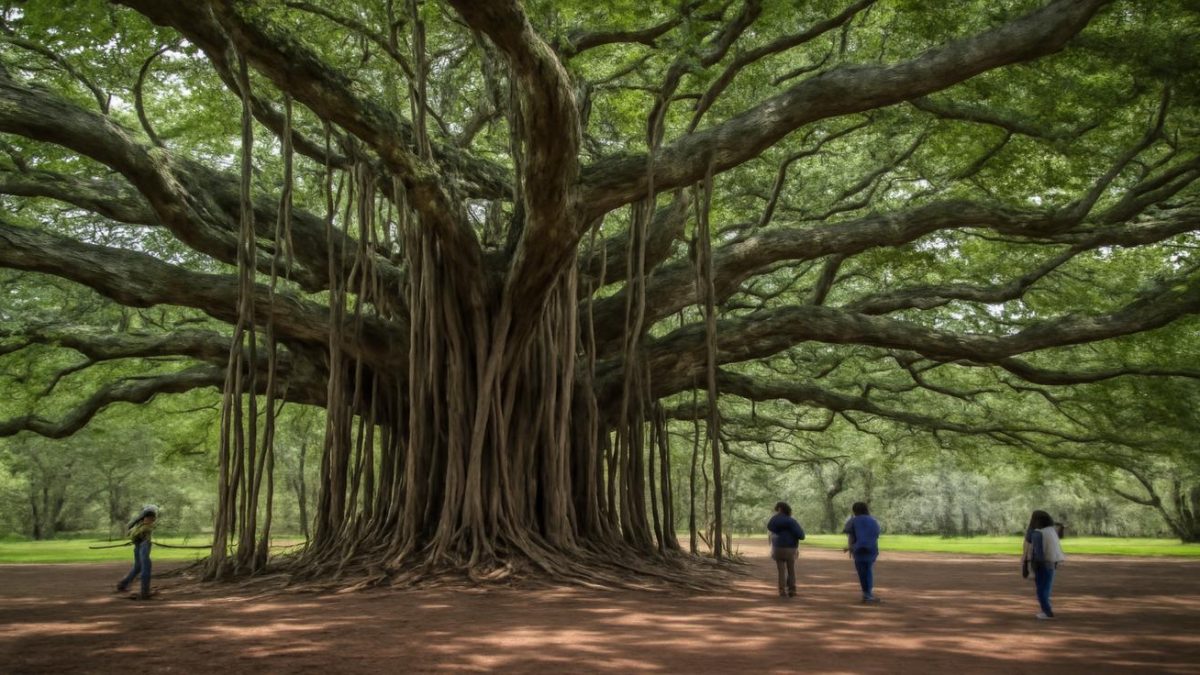
Picture stepping into what you instinctively believe is a lush, dense forest. Towering structures stretch overhead, creating a natural canopy that filters sunlight into dancing patterns on the ground below. The air carries that distinctive earthy forest scent, and you’re surrounded by what appears to be hundreds of individual trees standing shoulder to shoulder. Then comes the stunning revelation: you’re not in a forest at all. You’re standing beneath a single tree—one magnificent botanical specimen that has grown so expansively it now covers an area larger than a football field.
The Tree That Defies Imagination
This extraordinary living monument represents nature’s capacity for growth, resilience, and productivity on a scale that challenges our conventional understanding of what a single tree can achieve. Spanning across 8,500 square metres of land, this botanical giant stands approximately 20 metres tall—a relatively modest height that barely hints at its astronomical horizontal spread. The contrast between its height and width creates a uniquely distinctive silhouette that has captured the imagination of botanists, photographers, and nature enthusiasts worldwide.
What makes this tree particularly remarkable isn’t merely its size, but rather its form. Rather than growing upward in the typical pyramidal or columnar fashion that characterizes most tree species, this specimen has developed into a sprawling, horizontal crown that creates the perfect illusion of an entire woodland ecosystem contained within its branches. The sheer lateral expansion of its canopy creates a microclimate underneath that rivals that of a dense forest, complete with shade-loving plants thriving in its shelter and a complex ecosystem of insects, birds, and small mammals calling it home.
The Agricultural Powerhouse Hidden in Plain Sight
Beyond its visual magnificence and ecological importance lies another astonishing characteristic: its extraordinary productivity. During each harvest season, this single tree produces approximately 80,000 fruits. To put this number into perspective, a mature fruit tree of conventional dimensions typically yields between 200 and 1,000 fruits annually. This singular tree exceeds even the most optimistic expectations for any cultivated fruit-bearing plant, making it an agricultural phenomenon in its own right.
The sheer volume of fruit production raises fascinating questions about nutrient cycling, water uptake, and photosynthetic efficiency. The tree’s root system must be equally impressive, extending deep into the soil to draw up the vast quantities of water and minerals necessary to support such prolific fruiting. The photosynthetic surface area provided by millions of leaves must work in perfect harmony throughout the growing season to generate enough energy for fruit development. This level of productivity requires not just size, but an optimized biological system operating at peak efficiency.
Understanding the Science Behind the Marvel
The development of a tree to such extraordinary proportions typically requires several critical factors to align perfectly. The tree must grow in a climate with sufficient rainfall and temperature stability to support continuous growth throughout its lifespan. It requires soil rich in nutrients and minerals, with proper drainage to prevent waterlogging while maintaining adequate moisture availability. Protection from extreme weather events, pests, and diseases becomes increasingly important as the tree grows larger and more valuable.
Age plays an essential role in achieving such dimensions. Most trees reaching this scale have been growing for centuries, accumulating biomass year after year through consistent seasonal growth. The annual rings in a tree this size would likely number in the hundreds, with each ring telling a story of environmental conditions, pest pressures, and climatic patterns from decades or even centuries past. Some sections of its wood might have been formed during historical periods now measured in centuries.
The Ecological Importance of Giant Trees
Trees of this magnitude serve critical ecological functions that extend far beyond their aesthetic appeal. The massive canopy provides essential habitat for countless species of birds, insects, and small mammals. Epiphytic plants—those that grow on the tree’s branches without harming it—create additional layers of biodiversity. The tree itself acts as a carbon sink of significant proportions, sequestering thousands of tons of carbon dioxide throughout its lifetime and helping mitigate climate change at a localized and global scale.
The underground ecosystem beneath and around such a giant tree is equally complex. Mycorrhizal fungi form crucial relationships with the tree’s roots, facilitating nutrient exchange and water uptake. Soil microorganisms thrive in the rich, sheltered environment created by the tree’s presence. The tree’s leaf litter and fallen branches create a constant supply of organic matter, enriching the soil and supporting decomposer organisms essential to nutrient cycling.
Conservation and Protection Efforts
Trees of this calibre have increasingly become focal points for conservation efforts. Their ecological value, combined with their cultural and touristic significance, makes them worthy of protection and preservation for future generations. Many regions where giant trees occur have established protective legislation and management practices specifically designed to ensure their longevity.
These include measures to manage visitor access, preventing soil compaction and root damage from heavy foot traffic. Disease monitoring programs help identify and treat potential health threats before they become critical. Climate change adaptation strategies are being developed to help ancient trees survive changing environmental conditions. In some cases, seed collection and propagation programs ensure that genetic material from these remarkable specimens can be preserved even if the original tree faces unforeseen threats.
A Testament to Nature’s Potential
This single tree, occupying its expansive 8,500 square metres and producing 80,000 fruits annually, stands as a powerful reminder of nature’s extraordinary potential. It demonstrates what a living organism can achieve when given the right conditions, sufficient time, and freedom to grow without hindrance. In an era increasingly focused on environmental degradation and species loss, such botanical giants offer inspiration and hope.
Whether encountered in person or through photographs and descriptions, this remarkable tree challenges our assumptions about the natural world and reminds us that some of nature’s most impressive achievements operate on a scale that exceeds our everyday comprehension. It represents not just biological success, but a testament to the resilience, productivity, and majesty that the plant kingdom can achieve over the course of centuries.










Leave a Comment