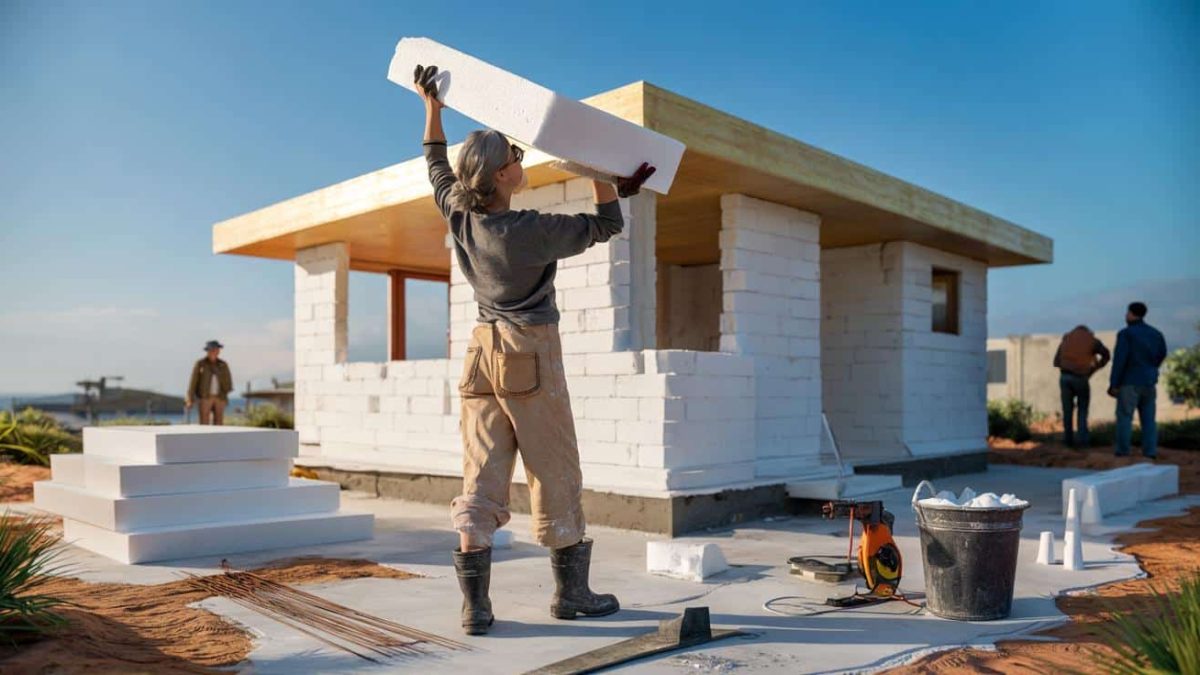
The housing crisis affects millions worldwide, yet solutions often seem trapped behind prohibitive costs and complex construction processes. What if the answer was simpler than we thought? In a modest suburb outside São Paulo, Brazil, one woman decided to stop waiting for traditional solutions and built her own—using materials that challenge everything we thought we knew about home construction.
Rejecting Convention for Innovation
Maria’s journey began with a simple question: why must housing be so expensive and complicated? While others debated zoning laws and material sourcing, she picked up polystyrene foam blocks and started building. This wasn’t an act of desperation, but rather a calculated experiment in rethinking construction from the ground up.
Polystyrene foam, commonly known as styrofoam, has been used for insulation for decades. Yet few had considered it as a primary structural material for entire homes. Maria saw potential where others saw waste material. Her vision was clear: create a weather-resistant, thermally efficient home that wouldn’t drain savings accounts or require years of mortgage payments.
The blocks she selected were rigid polystyrene foam boards, engineered to withstand compression and external stresses. Unlike casual assumptions about foam being fragile, these blocks provide surprising structural integrity when properly reinforced and finished. This distinction would become crucial to her project’s success.
The Engineering Behind Simplicity
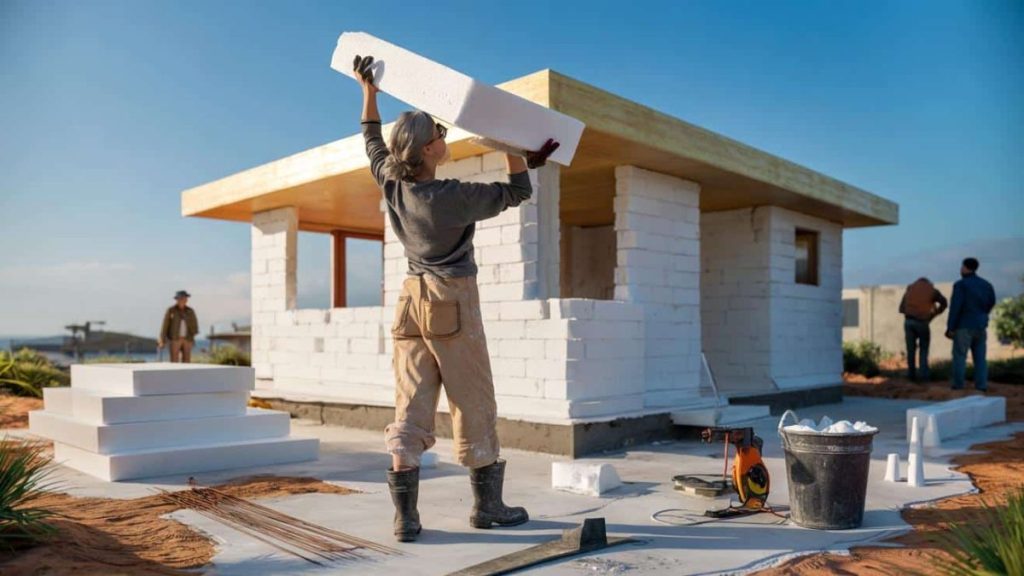
The structural system Maria employed relies on several key components working in concert. The foam blocks serve as the primary framework, stacked and bonded together with specialized adhesives designed specifically for foam materials. However, the real engineering comes from the reinforcement strategy.
Steel rebar and mesh netting are embedded within the foam structure, creating a composite system that distributes loads effectively. This hybrid approach borrows principles from reinforced concrete while maintaining the lightweight advantages of foam. The walls don’t rely solely on the foam’s compressive strength—instead, the steel elements bear the structural loads while the foam provides form, insulation, and weather protection.
Plaster serves as both protective coating and aesthetic finish, creating an external skin that shields the foam from ultraviolet radiation, which would otherwise degrade polystyrene over time. This layering system—foam, reinforcement, and plaster—creates a surprisingly robust envelope capable of withstanding Brazil’s challenging climate conditions.
The foundation work didn’t deviate dramatically from conventional methods. A concrete slab provides the base, ensuring moisture resistance and structural stability. This pragmatic choice acknowledges that some conventional solutions exist for good reasons, and the innovation focuses on walls and superstructure rather than abandoning all building science principles.
Weathering Nature’s Challenges
São Paulo’s subtropical climate presents genuine testing grounds for any construction method. Intense rainfall, high humidity, and powerful sun exposure have destroyed countless structures built with inferior materials or poor technique. Many skeptics questioned whether foam blocks could survive these conditions.
The plaster coating proved essential here. Applied in multiple layers with proper waterproofing additives, it creates a barrier preventing water infiltration. Unlike porous brick that absorbs moisture gradually, the foam-and-plaster system repels water when properly sealed. The hydrophobic nature of polystyrene actually works in the structure’s favor—the material itself resists water absorption.
Thermal performance exceeded expectations. Polystyrene’s exceptional insulation properties mean the interior maintains comfortable temperatures even during the region’s hottest months. This translates to dramatically reduced air conditioning needs and lower energy consumption. During cooler periods, the thermal mass retention keeps interiors warmer, reducing heating requirements.
The structural integrity has proven sound. The foam blocks don’t degrade under sun exposure when protected by proper plaster coating. The reinforced structure handles wind loads effectively, and the lightweight nature actually reduces seismic stress on the building system—an advantage in regions prone to earthquakes.
Economic Reality and Accessibility
Perhaps most compelling is the cost analysis. Traditional brick construction in Brazil, even with local materials, demands significant labor and material expenses. Maria’s foam-based approach reduced material costs by approximately sixty percent compared to conventional brick and concrete construction.
Labor efficiency improved dramatically. The lightweight blocks can be handled by two people, whereas brick laying traditionally requires skilled masons and more workers. The simplified process reduced construction time from months to weeks. Even accounting for specialized finishing work, the overall project cost remained a fraction of traditional building expenses.
This economic advantage carries profound implications. Affordable housing isn’t merely about reducing costs—it’s about enabling homeownership for people previously locked out by financial barriers. If construction methods can deliver comparable or superior quality at half the price, entire communities become accessible to families who’d otherwise remain renters indefinitely.
Sustainability Beyond Price Tags
Environmental considerations add another dimension to this approach. While polystyrene production requires energy and petrochemical inputs, the lifecycle analysis shows advantages. The superior insulation reduces operational energy consumption over the building’s lifespan, offsetting initial production impacts.
The lightweight structure requires less foundation work and material volume overall. Fewer resources are consumed in the complete construction process. When projects can be completed faster with fewer workers, transportation emissions and resource waste decrease substantially.
Additionally, this method offers opportunities for recycled polystyrene utilization. Post-consumer foam waste, typically destined for landfills, could be repurposed into building blocks, creating circular economy benefits while solving both housing and waste management challenges.
Scaling the Vision
Maria’s single home, while impressive, represents a proof-of-concept rather than a complete solution. Real transformation requires scaling—developing standardized block systems, training construction workers, establishing supply chains, and navigating building codes in different regions.
Several Brazilian municipalities have begun reviewing these alternative construction methods seriously. Engineers are testing foam-based structures in different climates. Architects are exploring design possibilities the method enables. What seemed radical eighteen months ago increasingly appears inevitable.
Looking Forward
One woman’s decision to build differently has sparked conversations reaching beyond her suburban neighborhood. Housing professionals, economists, and environmental scientists recognize the implications. When affordable housing quality no longer requires traditional expensive materials and methods, the conversation shifts from “can we afford housing?” to “how quickly can we implement solutions?”
Maria’s house stands as quiet testimony to the power of questioning assumptions. It demonstrates that innovation doesn’t require high technology or complex financing—sometimes it simply requires someone willing to try something different.







Leave a Comment