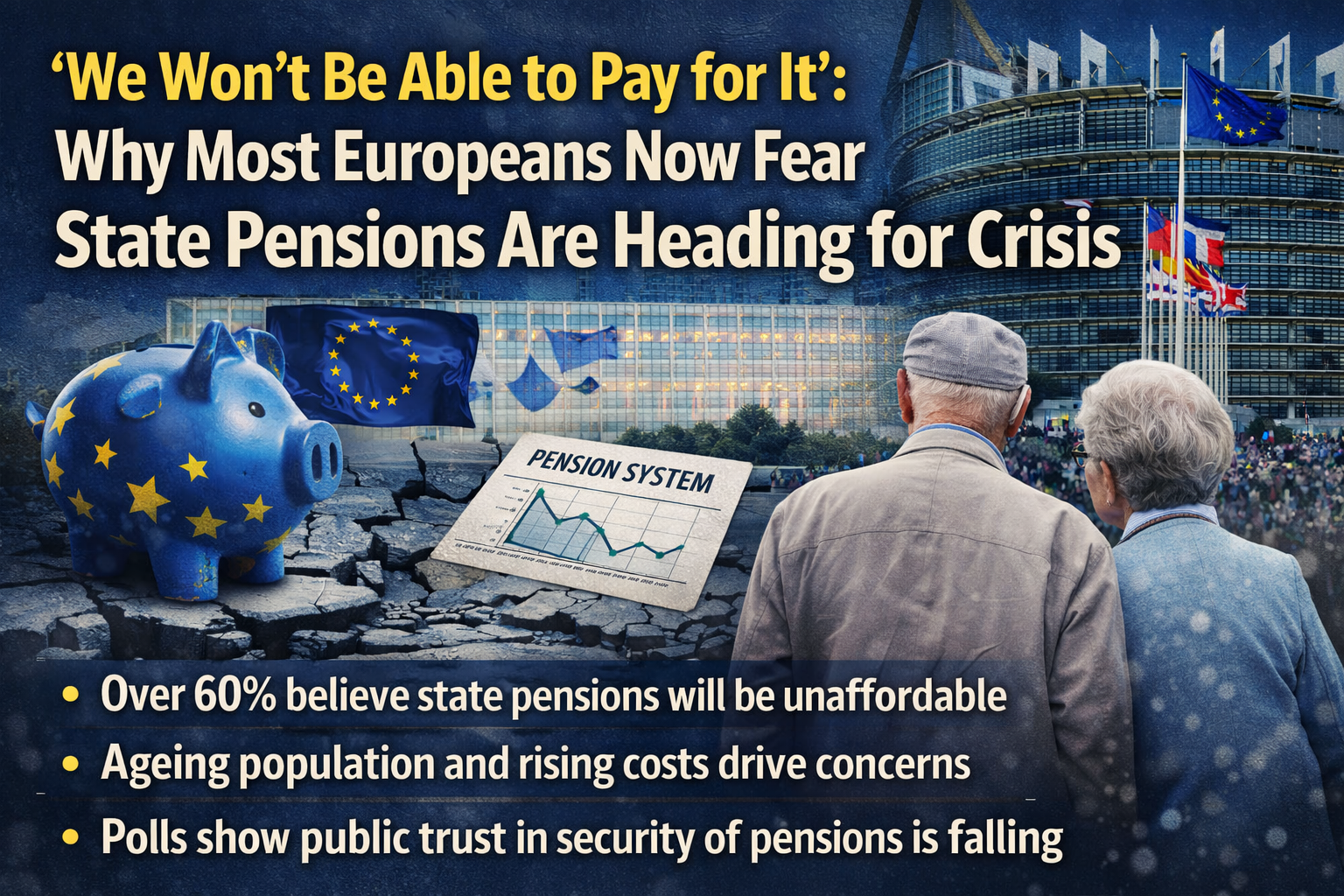
A growing majority of Europeans believe their state pension systems will become unaffordable, according to recent polling trends across the continent. The finding exposes a deep and widening gap between public confidence and political promises, as ageing populations, stretched public finances, and repeated pension reforms fuel anxiety about retirement security.
From young workers just starting their careers to older citizens approaching retirement, the same question is being asked across Europe: will the state still be able to pay pensions in the decades ahead? This Discover-style report breaks down what polling shows, why fears are rising, how concerns differ by country and generation, and what the future of European state pensions is likely to look like.
Public Opinion Shifts: Confidence in State Pensions Is Eroding
Across Europe, polling consistently shows that more people believe state pensions are becoming financially unsustainable than those who think they are secure. While optimism has not disappeared entirely, scepticism is now the dominant mood.
Key patterns emerging from surveys include:
-
A strong belief that governments will raise retirement ages further
-
Widespread expectation that benefits will shrink in real terms
-
Low confidence that younger generations will receive pensions comparable to today’s retirees
This shift in perception is not happening in isolation. Over the past decade, Europeans have seen pension rules change repeatedly, reinforcing the idea that retirement promises are fragile.
Why Europeans Think Pensions Are Becoming Unaffordable
An Ageing Continent Under Pressure
Europe’s population is ageing faster than almost anywhere else in the world. Fewer births and longer life expectancy mean a shrinking workforce supporting a growing number of retirees.
In many countries:
-
The number of people over 65 is rising rapidly
-
The working-age population is stagnating or declining
-
Pension systems rely heavily on current workers’ contributions
This imbalance is central to public fears. Many Europeans understand that pay-as-you-go systems struggle when demographics shift, and polling suggests people are increasingly aware of this structural problem.
Living Longer, Retiring Longer
Life expectancy gains are one of Europe’s great successes — but they come at a cost. Pension systems designed decades ago did not anticipate retirees drawing benefits for 20 to 30 years.
For the public, this raises concerns that:
-
Contribution periods are too short
-
Pension payouts last too long
-
Governments will eventually cut costs by reducing generosity
As a result, many Europeans believe affordability can only be restored through less favourable retirement terms.
Budget Strain and Competing Priorities
Pensions already account for a large share of national spending in most European countries. At the same time, governments face growing costs linked to:
-
Healthcare
-
Climate transition
-
Defence and security
-
Debt servicing
Polling suggests many citizens believe pensions will become a target for savings, not because they are unpopular, but because they are expensive.
Polling Snapshot: How Europeans View Pension Sustainability
The table below summarises how public opinion tends to break down across Europe based on recent multi-country polling patterns.
Public Perception of State Pension Affordability
| Group / Region | Dominant Public View | Main Concern |
|---|---|---|
| Young adults (18–35) | Pensions unlikely to survive unchanged | Retirement age too high |
| Middle-aged workers (36–55) | System under serious strain | Reduced benefits |
| Current retirees | Pensions will continue but weaken | Inflation erosion |
| Southern Europe | High scepticism | Past austerity cuts |
| Eastern Europe | Low trust | Demographic decline |
| Northern & Western Europe | Cautious concern | Long-term sustainability |
This data highlights a generational divide, with younger Europeans the least confident of all.
The Generational Gap Driving Pension Anxiety
Young Workers: “We’re Paying, But Will We Get Anything Back?”
Young Europeans are consistently the most pessimistic group in pension polling. Many believe:
-
They will retire much later than their parents
-
State pensions will cover only basic needs
-
Private savings will be essential for survival
This perception is changing behaviour. Younger workers are more likely to:
-
Save independently
-
Invest earlier
-
Expect less from the state
However, lower-income workers often lack the ability to save, deepening fears of future inequality.
Older Workers and Retirees: A Different Set of Fears
Older Europeans tend to worry less about total system collapse and more about gradual erosion. Their main concerns include:
-
Pension increases failing to keep up with inflation
-
Changes to indexation rules
-
Rising healthcare and living costs
This difference in outlook fuels political tension, as reforms often protect current retirees while shifting burdens onto future generations.
How Governments Are Responding
Raising the Retirement Age
Linking retirement age to life expectancy has become a common policy across Europe. While it improves affordability, polling shows it is one of the least popular reforms, often sparking protests.
Reducing Long-Term Costs Quietly
Rather than dramatic cuts, many governments are:
-
Slowing pension increases
-
Adjusting calculation formulas
-
Tightening eligibility rules
These changes are less visible but have a significant long-term impact — and voters are increasingly aware of them.
Promoting Private and Occupational Pensions
To offset pressure on state systems, governments are encouraging private savings through:
-
Auto-enrolment schemes
-
Workplace pensions
-
Tax incentives
Public trust in these alternatives is mixed, especially among those with unstable incomes.
Are State Pensions Really Becoming Unaffordable?
Despite public pessimism, most experts agree that state pensions are unlikely to disappear entirely. Instead, they are expected to evolve.
Likely future characteristics include:
-
Higher retirement ages
-
Lower replacement rates
-
Greater reliance on mixed public-private income
-
Stronger focus on poverty prevention rather than income replacement
In short, pensions may remain affordable — but less generous and more unequal than in the past.
Why Public Perception Matters
Even if systems remain technically sustainable, belief matters. When citizens lose faith in pensions:
-
Trust in government declines
-
Political instability increases
-
Households save defensively
-
Economic growth slows
Pension anxiety does not stay confined to retirement policy — it affects the entire economy.
Economic Consequences of Pension Fear
Widespread concern about pensions can lead to:
-
Delayed retirement, blocking job mobility
-
Lower consumer spending
-
Increased inequality between savers and non-savers
-
Greater dependence on family support
These effects reinforce the very pressures that make pension systems harder to sustain.
The Political Risk Ahead
Pensions remain one of the most sensitive political issues in Europe. Polling shows:
-
Strong resistance to cuts
-
Low tolerance for sudden reforms
-
High expectations of fairness across generations
Governments face a difficult balancing act: reform too slowly and risk insolvency; reform too fast and face voter backlash.
What the Future Most Likely Holds
While most Europeans fear state pensions will become unaffordable, the more realistic outcome is a gradual transformation, not collapse.
The emerging model across Europe looks like this:
-
The state provides a basic safety net
-
Individuals shoulder more responsibility
-
Retirement ages rise incrementally
-
Benefits focus on preventing poverty, not maintaining living standards
Whether this transition succeeds depends largely on public trust, which polling suggests is currently fragile.
Final Takeaway
The belief that state pensions are becoming unaffordable is now widespread across Europe — and it is shaping behaviour, politics, and economic choices. Polling reveals not panic, but deep uncertainty.
For governments, the challenge is no longer just funding pensions, but convincing citizens that the system remains fair, reliable, and worth supporting. Without that confidence, even sustainable pension systems risk long-term instability.









Leave a Comment