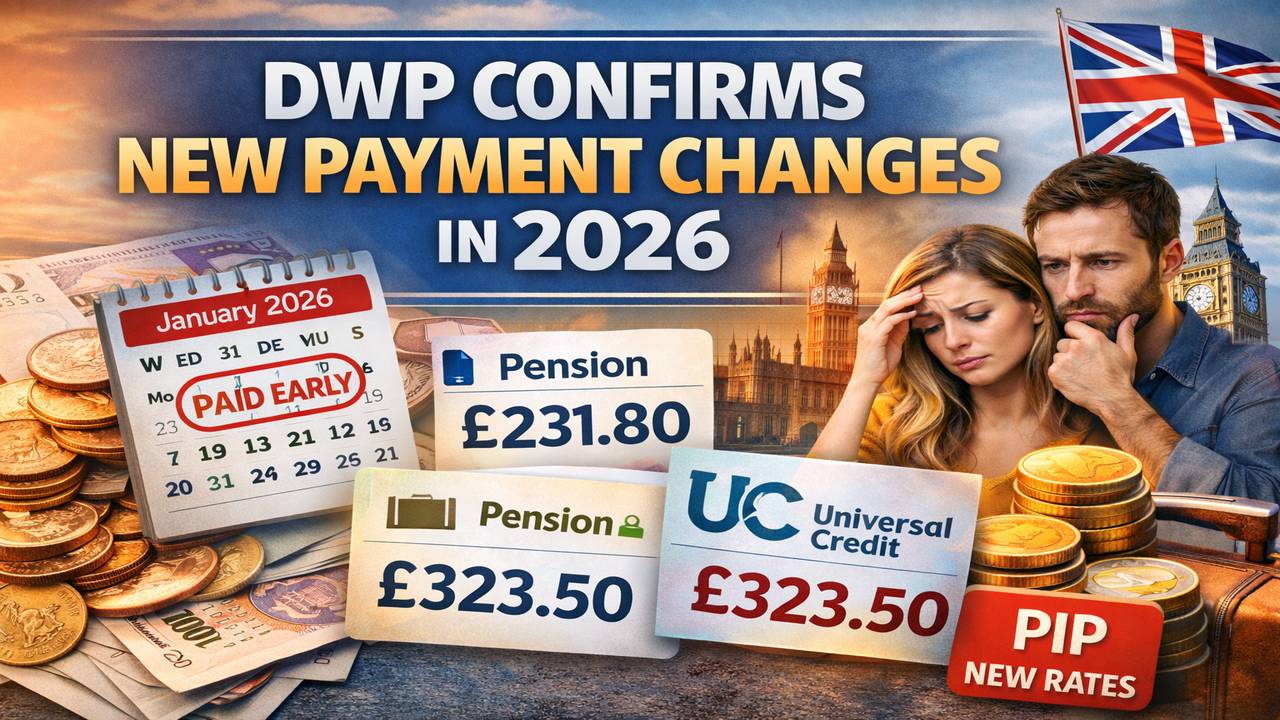
The UK benefits system is set for another major shift in 2026, after the Department for Work and Pensions confirmed a series of payment changes, uprating increases, and policy updates that will affect millions of people across the country.
While inflation has eased compared to previous years, the cost of living remains high, and the government says these changes are designed to offer stability, protect vulnerable households, and adjust support in line with economic conditions.
But what exactly is changing?
Who gains more money, who needs to plan carefully, and which payments will arrive earlier than usual?
Here is a full, clear breakdown of all confirmed DWP payment changes in 2026, explained simply — without jargon.
Why 2026 Is a Big Year for DWP Payments
The year 2026 marks a transition period for the UK welfare system.
Several long-planned reforms are finally coming into force, while others reflect more recent decisions linked to:
-
Inflation trends
-
Public spending pressures
-
Ongoing Universal Credit migration
-
Rising benefit claimant numbers
For many households, payment timing and amount changes will matter just as much as headline increases.
Early DWP Payments in January 2026 Explained
One of the most important confirmed changes involves payment dates around New Year 2026.
Because 1 January 2026 is a UK bank holiday, the DWP has confirmed that many benefit payments due on that date will be paid early.
What This Means
-
Payments scheduled for Thursday 1 January 2026 will instead be paid on
Wednesday 31 December 2025 -
Payments after this date return to normal schedules
-
No extra money is paid — it is simply paid earlier
This affects millions of claimants, so budgeting carefully is essential.
Benefits Affected by January 2026 Early Payments
| Benefit Type | Early Payment Applies? |
|---|---|
| Universal Credit | ✅ Yes |
| State Pension | ✅ Yes |
| Personal Independence Payment (PIP) | ✅ Yes |
| Disability Living Allowance (DLA) | ✅ Yes |
| Employment and Support Allowance (ESA) | ✅ Yes |
| Jobseeker’s Allowance (JSA) | ✅ Yes |
| Child Benefit | ✅ Yes |
| Pension Credit | ✅ Yes |
📌 Important: Early payments must last longer until the next payment date.
Benefit Payment Increases from April 2026
The biggest financial changes arrive in April 2026, when most benefits are uprated.
The DWP uses inflation data from the previous year to decide how much payments increase.
Key Point
These increases do not fully reverse past cost-of-living rises, but they are designed to stop incomes falling further behind prices.
DWP Confirms Christmas and New Year Payment Changes for Pensions and Benefits
Estimated DWP Benefit Increases for 2026
| Benefit | Expected Change |
|---|---|
| Universal Credit (standard allowance) | Inflation-linked rise |
| State Pension (new & basic) | Higher uprating than most benefits |
| PIP & DLA | Inflation-linked increase |
| ESA & JSA | Inflation-linked increase |
| Pension Credit | Inflation-linked increase |
| Child Benefit | Increase expected |
💡 Exact weekly and monthly amounts are applied automatically — no action needed.
State Pension Changes in 2026
Pensioners remain one of the most protected groups in the welfare system.
In 2026:
-
Both the new State Pension and basic State Pension increase
-
Payments rise from April 2026
-
Changes reflect earnings, inflation, or protection mechanisms
For many pensioners, this means higher weekly payments, but rising housing and energy costs still remain a concern.
Universal Credit: What’s Changing in 2026
Universal Credit continues to be the core working-age benefit, and 2026 brings mixed changes.
What’s Staying the Same
-
Monthly payment structure
-
Online account system
-
Work allowance rules
What Is Changing
-
Standard allowance uprated
-
Some health-related elements reduced for new claimants
-
Transitional protections for existing claimants
Universal Credit Health Element Changes (Important)
From April 2026, the DWP is introducing changes to the health-related element of Universal Credit.
Key Details
-
New claimants assessed as having limited capability for work may receive lower health-related payments
-
People with severe or terminal conditions are protected
-
Existing claimants keep current amounts through transitional protection
This change has been one of the most debated reforms, with charities warning some households could feel pressure over time.
Two-Child Limit Change in 2026
One of the most significant policy changes is the removal of the two-child limit from April 2026.
What This Means
-
Families will no longer be restricted to support for only two children
-
Applies to Universal Credit child elements
-
Expected to benefit larger families
This change is aimed at reducing child poverty and supporting household stability.
Migration to Universal Credit Continues
The DWP is continuing the final phase of moving people from:
-
Tax Credits
-
Housing Benefit (working-age)
-
Income Support
-
Legacy benefits
into Universal Credit.
Important Safeguards
-
Claimants receive migration notices
-
Transitional protection prevents sudden income drops
-
Support is available during the switch
📌 Ignoring a migration notice can risk payments stopping.
Disability Benefits in 2026: PIP and DLA
Disability benefits remain separate from Universal Credit and are not means-tested.
In 2026:
-
PIP and DLA payments increase in line with inflation
-
Assessment rules remain broadly unchanged
-
Reviews continue as normal
Claimants do not need to reapply for uprating increases.
Cost of Living vs Benefit Increases: The Reality
While benefits rise in 2026, many households say:
-
Rent increases cancel out gains
-
Energy bills remain unpredictable
-
Food costs stay high
This gap between support levels and real costs explains why financial pressure continues even after uprating.
How to Prepare for DWP Changes in 2026
Practical Steps
-
Check your January payment date
-
Budget early payments carefully
-
Watch for Universal Credit messages
-
Update bank details if needed
-
Seek advice before migration deadlines
Local councils and charities continue to offer free benefit advice.
What the DWP Says About 2026 Changes
The Department for Work and Pensions says the changes are designed to:
-
Protect the most vulnerable
-
Maintain fairness
-
Balance public finances
-
Encourage work where possible
However, debate around welfare spending and eligibility is expected to continue throughout 2026.
What Happens Next?
Looking ahead:
-
Further welfare reviews are expected
-
Housing support remains under pressure
-
Benefit adequacy will remain a political issue
-
Any new reforms would likely follow after 2026
For now, 2026 is about adjustment rather than overhaul.
✅ State Pension Payment Amounts (From April 2026)
| State Pension Type | Weekly Amount (2025/26) | Weekly Amount (From Apr 2026) | Annual Amount |
|---|---|---|---|
| New State Pension | £221.20 | £231.80 | £12,054 |
| Basic State Pension | £169.50 | £177.60 | £9,235 |
📌 Who this affects:
-
Men born after 6 April 1951
-
Women born after 6 April 1953
-
Older pensioners on the basic system
✅ Universal Credit – Standard Allowance (Monthly)
| Claimant Type | Monthly (2025/26) | Monthly (From Apr 2026) |
|---|---|---|
| Single under 25 | £311.68 | £323.50 |
| Single 25+ | £393.45 | £408.40 |
| Joint under 25 | £489.23 | £507.80 |
| Joint 25+ | £617.60 | £641.10 |
📌 Paid monthly into your bank account
📌 Uprating applied automatically
✅ Universal Credit – Child Element (After Two-Child Limit Removal)
| Child Element | Monthly Amount (From Apr 2026) |
|---|---|
| First child | £333.30 |
| Each additional child | £287.90 |
📌 Important 2026 change:
From April 2026, all children are counted, not just the first two.
✅ Universal Credit – Health & Disability Elements
Limited Capability for Work & Work-Related Activity (LCWRA)
| Status | Monthly Amount |
|---|---|
| Existing claimants | £416.19 (protected) |
| New claimants (from Apr 2026) | £208.10 |
📌 Existing claimants keep higher rate under transitional protection.
✅ Personal Independence Payment (PIP) – Weekly Rates
Daily Living Component
| Level | Weekly | Monthly |
|---|---|---|
| Standard | £75.90 | £328.70 |
| Enhanced | £101.75 | £440.90 |
Mobility Component
| Level | Weekly | Monthly |
|---|---|---|
| Standard | £30.10 | £130.40 |
| Enhanced | £79.80 | £345.80 |
📌 PIP is tax-free and not means-tested
✅ Employment and Support Allowance (ESA) – Weekly
| Group | Weekly Amount |
|---|---|
| Assessment phase | £90.50 |
| Support group | £138.20 |
✅ Jobseeker’s Allowance (JSA) – Weekly
| Claimant | Weekly Amount |
|---|---|
| Under 25 | £90.50 |
| 25 and over | £114.10 |
✅ Child Benefit Payments (Weekly)
| Child | Weekly Amount |
|---|---|
| Eldest / only child | £26.05 |
| Additional children | £17.25 |
📌 Paid every 4 weeks unless weekly payments requested
✅ Pension Credit (Weekly Guarantee)
| Household Type | Weekly Amount |
|---|---|
| Single person | £228.60 |
| Couple | £349.80 |
🔔 January 2026 Early Payment Reminder (Important Table)
| Normal Payment Date | Actual Payment Date |
|---|---|
| Thursday 1 Jan 2026 | Wednesday 31 Dec 2025 |
📌 Applies to all DWP benefits & State Pension
Summary: What You Should Remember
✔ Early payments in January 2026
✔ Benefit increases from April 2026
✔ Universal Credit health changes for new claimants
✔ Two-child limit removed
✔ Ongoing Universal Credit migration
✔ No action needed for uprating increases
FAQs: DWP Payment Changes 2026
Will I get paid early in January 2026?
Yes, if your payment is due on 1 January.
Do I need to apply for the increase?
No — uprating is automatic.
Are benefits being cut in 2026?
Some elements change for new claimants, but most benefits increase.
Will pensioners get more money?
Yes, State Pension payments increase from April 2026.
Is Universal Credit ending?
No, it remains the main benefit system.











Leave a Comment